

In this LCGC Blog, Daipayan Roy and Muhammed Qamar Farooq of Amgen discuss the history and impact of supercritical fluid chromatography (SFC) throughout the years.
In this LCGC Blog, Daipayan Roy and Muhammed Qamar Farooq of Amgen discuss the history and impact of supercritical fluid chromatography (SFC) throughout the years.

In this LCGC Blog, Daipayan Roy and Muhammed Qamar Farooq of Amgen discuss the history and impact of supercritical fluid chromatography (SFC) throughout the years.

LCGC North America
We explore the developments that have made it possible to produce sub-minute, and, more recently, even sub-second enantiomeric separations. We also look at the questions that remain unanswered.

LCGC Europe
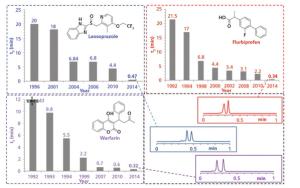
Compared to the progress made in reversed phase separations in terms of speed and efficiency, chiral chromatographers have traditionally focused on improving the selectivity of enantiomeric separations by synthetic procedures. As a result, more than 50 different types of advanced chiral stationary phase chemistries are available today. Traditionally, speed and efficiency of chiral chromatography has not received attention until recently. With the availability of superficially porous particles and sub-2-µm particles, sub-minute enantiomeric separations have been achieved with the help of improved particle technology with narrow size distribution, and systematic studies on packing columns. This article covers advances made in the field of ultrafast chiral chromatography in the last decade. The development of instrumentation technology has also contributed immensely to making sub-second chiral separations a reality. Enantiomeric separations can now compete with the speed of sensors. Future directions and unanswe

June 1st 2018
August 1st 2018

October 13th 2024
