




A recent joint study between the University of Ferra and YMC ChromaCon led an effort to a new approach to more efficiently purify oligonucleotides.
A recent joint study between the University of Ferra and YMC ChromaCon led an effort to a new approach to more efficiently purify oligonucleotides.

As part of our ISC 2024 coverage, we recently interviewed Amarande Murisier of the University Hospital of Lausanne, Switzerland (CHUV) about her winning the Rising Stars of Separation Science Award for Biopharmaceutcal Analysis and her scientific background.

In this article, we review some key considerations for chromatographic technique selection and method development across the full drug process.

At HTC-18 in Leuven, LCGC International spoke to Claudio Brunelli about the evolution of supercritical fluid chromatography (SFC) techniques in the pharmaceutical industry.

The 11th International Symposium on Recent Advances in Food Analysis will be in Prague, Czech Republic from 5–8 November 2024.

This article surveys the application of headspace-SIFT-MS to untargeted screening of food products and ingredients, such as beer, olive oil, Parmesan cheese, and strawberry flavor mixes.

In a recent study, scientists from Europe reflected over how more testing protocols must be created to monitor and control micro- and nanoplastics (MNPs) in soil.

This article explores the key challenges analytics and mass spectrometry solve within the biopharmaceutical industry.

The new technology can be used by analytical scientists working in a variety of industries including food and beverage, oil and gas, and more.

We provide a high-level overview of Current Good Manufacturing Practice (cGMP) regulations and their impact on the analytical chemist in the pharmaceutical industry.

Scientists based out of Zhejiang Academy of Agricultural Sciences in Hangzhou, China, recently used a new QuEChERS method for analyzing pesticides in fruit samples.
Researchers have developed a novel algorithm that combines multivariate curve resolution-alternating least-square (MCR-ALS) and Bayesian inference techniques to estimate confidence intervals for the quantitation of coeluted peaks in liquid chromatography-photodiode array detection.

Applying headspace-SIFT-MS to untargeted screening of food products and ingredients.

A recent study has introduced comprehensive quality control procedures for large-scale plasma proteomics analyses. The research provides valuable insights into optimizing performance, enhancing reproducibility, and ensuring quantitative accuracy in proteomics investigations.

Manufacturing capillary gas chromatography (GC) columns is a very complex procedure, with many production factors to consider. In this LCGC Blog, Tony Taylor lists some of the vital components of the GC column-making process.

Waters Corporation has purchased Wyatt Technology, expanding both parties' reach in biopharmaceutical development and creating better healthcare technology for all.

If your decision making relies on analytical chemistry, then you want to be confident that the measurements are an accurate representation of the matrix that is being analyzed, and that they are of “publication” quality. But how can you know for sure if the analytical laboratory that you’ve selected is producing reliable data?

Qualification and calibration of high performance liquid chromatography (HPLC) chromatographs is a regulatory requirement, but how proscriptive should guidance be?

Everyone who is reading this column is interested in chromatography, and I want to shine a light on the industrial side of the application space.

The Column
As a result of the pharmaceutical cGMP for the 21st century and quality by design (QbD) initiatives championed by regulators, the biopharmaceutical industry has been looking for ways to introduce more automated and higher information content analyses into manufacturing, late-development, and quality control (QC). Mass spectrometry (MS-) based attribute monitoring assays have been proposed as key tools to provide the sensitivity, throughput, selectivity, and flexibility required for monitoring critical product and process attributes for biopharmaceutical production and release. Two analytical workflows, subunit multi-attribute monitoring (MAM) and peptide MAM, have emerged to dominate this discussion, and this article is intended to reflect on the active debates over the needs, challenges, and practical limitations for adopting MS-based attribute monitoring for late-development and QC.

LCGC North America
Quantitative determination of the counterions associated with pharmaceutical salts is a mandatory requirement for quality control. While ion chromatography (IC) is the standard technique in most laboratories, capable of delivering excellent sensitivity, specificity and flexibility, there are other simpler and quicker analytical methodologies that may should be considered for this quality control application.

LCGC Europe
This fourth and last instalment in the “Separation Science in Drug Development” series provides an overview of modern practices of quality control in small-molecule drug development, including activities such as setting specifications, method validation and transfer, release and stability testing, and authoring chemistry, manufacturing, and controls (CMC) sections of regulatory filings.

The Column
Mass spectrometry (MS) is emerging as a critical tool in biopharmaceutical late stage development, manufacturing, and quality control (QC) environments. The rapid growth of biologics in development, the increasing demand for more robust analytical technologies to directly monitor the critical quality attributes (CQAs) of these new drugs, and longer term industry initiatives aimed at improving quality and productivity, such as quality by design (QbD) regulatory submissions and continuous manufacturing, are all fueling a greater need for mass monitoring with MS.

LCGC North America
This fourth and last installment in the series of “Separation Science in Drug Development” provides an overview of modern practices of Quality Control in small molecule drug development including activities such as setting specifications, method validation/transfer, release and stability testing, and authoring CMC sections of regulatory filings.
The Column
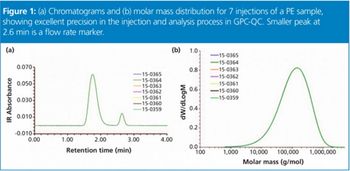
A method specifically developed to measure the molar mass distribution (MMD) of polyolefins in a manufacturing plant laboratory has been developed. It is demonstrated that the total cycle time, including the sample dissolution step, can be reduced to around 30 min, well in line with the process control requirements.