

Sponsored Content
This application note investigates the differences between packaging of normal and inferior hand-sanitizing wipes using EGA and multi-step pyrolysis GC–MS.
Sponsored Content
This application note investigates the differences between packaging of normal and inferior hand-sanitizing wipes using EGA and multi-step pyrolysis GC–MS.
Sponsored Content
Field-flow fractionation coupled to online light scattering detectors determines detailed size and structural information for nanoparticle-based therapeutics.
Quantitative analysis of polymer contamination in solvents by pyrolyzing the sample into a GC–MS.
Characterization of technical polymers by light scattering and field-flow fractionation (FFF-MALS) is reviewed and contrasted with the more common technique, SEC-MALS.
Combining the benefits of the ACQUITY APC System with the ACQUITY UPLC Refractive Index (RI) Detector and the ACQUITY QDa Mass Detector yields laboratory efficiencies.
The selection of appropriate column chemistries to separate eighteen polymer additives are routinely monitored in extractables and leachables (E&L) workflows.
A flexible analytical system was used in conjunction with a well-defined informatics workflow to elucidate degradation markers in Li-Ion battery electrolytes.
Combining the APC System with WinGPC UniChrom™ software allows researchers to increase the peak capacity of their research.
Collaborative efforts at Virginia Tech University drive better materials through polymer innovation and additive manufacturing.
The analytical performance of the CDS 7000 Series Purge and Trap concentrator is demonstrated for the EPA Method 8260C by GC–MS analysis.
This article demonstrates the sensitivity of an automated thermal desorber coupled to a GC–MS for TO-17 VOCs analysis targeting from propene to naphthalene.
This application note demonstrated the quantitative analysis of 26 fragrance compounds by a PAL system equipped with a dynamic headspace module.
This application note demonstrates a quantitative analysis of δ9-Tetrahydrocannabinol (THC) from a commercial cannabidiol oil sample.
This application note demonstrates the performance of Empore C18 disk in the monitoring of drinking water samples under EPA Method 525.2.
This application note demonstrates using evolved gas analysis and multi-step pyrolysis as a powerful toolset to unveil both additives and polymer backbone.
Sponsored Content
- Conventional light scattering comes with various limitations - New light scattering technology benefits protein/polymer characterization
Sponsored Content - AP
Comprehensive physicochemical characterization of biopolymers is accomplished by adding multi-angle light scattering and differential viscometry to standard SEC.
Sponsored Content - EU
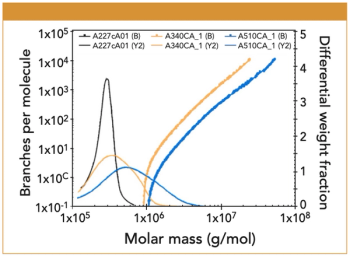
Branching impacts polymer properties such as rheology and stiffness. This note explains the analysis of branching ratio versus molar mass, accomplished by SEC-MALS(-IV).

LCGC Europe
How do bioinert and biocompatible liquid chromatography (LC) systems and columns improve separations of biomolecules? How do I know when these systems are required for my separation?

Sponsored Content - NA
This study describes the separation of nanoplastics and determination of their surface charge by electrical asymmetrical flow field-flow fractionation.
Sponsored Content - EU
This study describes the separation of nanoplastics and determination of their surface charge by electrical asymmetrical flow field-flow fractionation.
Sponsored Content
Sponsored Content - NA
Antibody molecular weight analysis can now be easily performed on the Shodex PROTEIN LW-803.
Sponsored Content
What you will learn: - How miniaturization can be applied to gel permeation chromatography - Considerations and benefits of the approach for size-based separations
Sponsored Content - NA
A simple 20-minute extraction to quickly prep plastics for additive analysis by UPLC.