



Field-Flow Fractionation (FFF)
Latest News
Advertisement
Latest Videos
Shorts
Advertisement
More News

Field-flow fractionation (FFF) coupled to light scattering is a powerful method to separate and characterize nanoparticles, proteins, and polymers from a few nanometres to a few micrometres. The technique is one of the few that can cover the full size range of nanomaterials and provide high-resolution size distributions and additional characterization. New developments in FFF enhance performance and productivity.
The Column
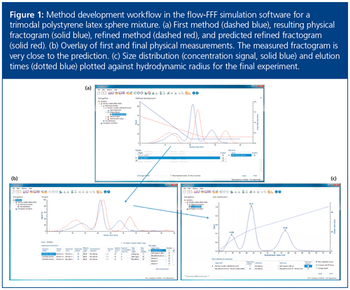
Flow-field flow fractionation (flow-FFF) offers highly versatile separations for the analysis of complex fluids, covering a size range of macromolecules and particles from 1 nm to 10,000 nm. However, flow-FFF is often perceived as a difficult technique to learn because of the multiple parameters available for adjustment. Recent advances in software for simulating flow-FFF overcome this obstacle, enabling the virtual optimization of flow-FFF methods and opening up the power of flow-FFF separations to non-experts. An added benefit is the ability to easily analyze particle size distributions by elution time from first principles.

LCGC Europe
The evaluation of the oral uptake of engineered nanoparticles (ENPs) contained in personal care products like mouthwashes is of great relevance to estimate the potential hazards and the toxicity of engineered nanomaterials (ENMs). Various experiments were performed while two commercially available mouthwash products (named M1 and M2) were selected as samples of interest. Asymmetric flow field‑flow fractionation (AF4) was chosen and optimized as the particle separation technique and two detectors were on-line coupled while dynamic light scattering (DLS) was used for evaluation and signals obtained by ultraviolet–visible (UV–vis) detection at 254 nm were used to gather additional information about the fate of the ENPs.

LCGC North America
The evaluation of the oral uptake of engineered nanoparticles (ENPs) contained in personal care products like mouthwashes is of great relevance to estimate the potential hazards and the toxicity of engineered nanomaterials (ENMs). Various experiments were carried out while two commercially available mouthwash products (named M1 and M2) were selected as samples of interest. Asymmetric flow field-flow fractionation (AF4) was chosen and optimized as particle separation technique and two detectors were on-line coupled while dynamic light scattering (DLS) was used for evaluation and signals obtained by UV-vis at 254 nm were used to gather additional information about the fate of the ENPs.

The Column
Nanoparticles hold enormous potential for targeted, well-controlled drug delivery. Extensive characterization of nanoscale drug-delivery vehicles is essential to ensure their efficacy and reproducibility. While various methods are available to characterize nanoparticle size, including dynamic light scattering (DLS), electron microscopy, and nanoparticle tracking analysis, field-flow fractionation–multi-angle light scattering (FFF–MALS) is one of the most versatile techniques to determine size, structure, and other properties. This article highlights a study demonstrating the benefits of FFF–MALS–DLS for the characterization of nanolipid particles.
LCGC North America
This review highlights applications for which AF4 is particularly well suited, and explains when not to use the technique.
LCGC Europe
Characterization of macromolecules and colloids is an area of considerable interest. Asymmetrical flow field-flow fractionation (AF4) has become a well-established method, but many potential users possess limited knowledge of its capabilities, and that it can provide additional information or serve as validation to the traditional analytical techniques. This review article highlights several practical applications in which AF4 should be given special consideration, and discusses benefits and drawbacks of the different methods.

The Column
The fate and modification of nanoparticles in real life matrices can be investigated by the combination of field-flow fractionation (FFF) with inductively coupled plasma mass spectrometry (ICP–MS). This article explains more.

Field-Flow Fractionation for Biological, Natural, and Synthetic Polymers: Recent Advances and Trends
LCGC Europe
A review of the latest trends in field-flow fractionation (FFF) for various types of polymer analysis.

Field-Flow Fractionation for Biological, Natural, and Synthetic Polymers: Recent Advances and Trends
LCGC North America
The recent advances in FFF over the last three years are highlighted in this review.

The Column
The functional principles of AF4 and HF5 are discussed.

Field-Flow Fractionation for Biological, Natural, and Synthetic Polymers: Recent Advances and Trends
LCGC Asia Pacific
A review of the latest trends in field-flow fractionation (FFF) for various types of polymer analysis.

LCGC Europe
This article provides an overview of the capabilities of field-flow fractionation coupled with inductively coupled plasma–mass spectrometry and demonstrates that the technique shows a great deal of promise to separate, detect and quantitate nanoparticles in environmental matrices.

The Column
1 + 1 = 3. Say what? That's not what I learned in school! But it's true: when you couple the best of two technologies together, the output is better than the sum of the parts. As you'll see in this article, that's exactly what you get when you couple field flow fractionation to an ICP-MS detector for the analysis of nanomaterials.
The Column
This work demonstrates the potential of the simultaneous on-line hyphenation of asymmetric flow field flow fractionation (AF4) to inductively coupled plasma-mass spectrometry (ICP-MS) and ultra violet-visible/multi angle light scattering (UV-vis/MALS) detection as a promising and simple tool to obtain information on the multi-element speciation and absolute molecular mass of human plasma proteins such as albumin and transferrin: the two main proteins that have been proposed to bind and transport metal ions in this biological fluid.

LCGC Europe
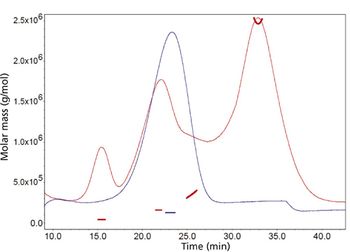
Describes how asymmetrical flow field flow fractionation (AF4) can be used to characterize intermolecular interactions in multifunctional polymers used in drug delivery.
LCGC Asia Pacific
Demonstrating that flow field-flow fractionation can separate protein aggregates for preparative and analytical purposes.

LCGC Europe
Demonstrating that flow field-flow fractionation can separate protein aggregates for preparative and analytical purposes.

LCGC North America
This article illustrates how to choose the best experimental parameters for asymmetrical flow field-flow fractionation.

LCGC Europe
This article describes some of the latest developments for the analysis of polymers and nanoparticles.

LCGC North America
The rational development of AF4 methods for the investigation of VLP is illustrated.

LCGC North America
Asymmetric flow field flow fractionation is a type of field flow fractionation (FFF) separation technique. FFF has been co-existing with size exclusion chromatography (SEC) for several decades.
Wyatt Technology (Santa Barbara, California) has announced that it will be hosting a field flow fractionation-multiangle light scattering (FFF-MALS) meeting on October 22, 2008, at the Bacara Resort and Spa in Santa Barbara.
Advertisement
Advertisement
Trending on LCGC International
1
Prioritizing Unknowns in Nontarget Screening of Food Samples
2
AI ML Now: Gert Desmet on the Future of Artificial Intelligence and Machine Learning in Separation Science
3
Jan Christensen on Quantitative Non-Targeted Screening
4
Conversations with Michael Dong: Buffers for Mobile Phase A in Pharmaceutical Analysis
5