

PharmTech LCGC Sciex Webinar 11.10

Application Notes: Food and Beverage

Sponsored Content

Per‑ and polyfluoroalkyl substances (PFAS) are persistent environmental contaminants that can accumulate in animal‑derived foods, creating growing regulatory and public health concerns. Traditional PFAS testing methods often rely on time‑consuming solid‑phase extraction (SPE) and extensive cleanup to manage complex tissue matrices. This application note demonstrates a simplified, high‑throughput Blend & Inject LC‑MS/MS workflow using the PerkinElmer QSight® 500 LC‑MS/MS system for reliable PFAS quantification in animal‑derived food products while meeting stringent EU and EPA regulatory requirements.
Sponsored Content

PFAS rules now reach the packaging itself. Under the EU Packaging and Packaging Waste Regulation, food contact packaging containing 25 ng/g or more of any individual PFAS cannot be placed on the market, so labs need targeted data at production volume. This application note shows a Direct Shoot LC-MS/MS method on the PerkinElmer QSight 500 system that quantifies 26 PFAS in food packaging bottles, pharmaceutical packaging bottles and packaged drinking water. It uses a simple methanol extraction and no SPE cleanup. Calibration runs from 0.05 to 25 ng/g, with recoveries predominantly within 70 to 130%.

Sponsored Content

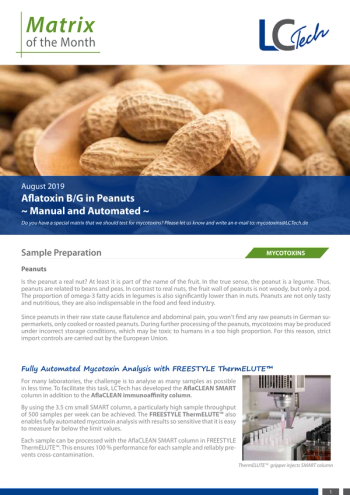
See how mycotoxin sample preparation in peanuts can be faster and more efficient with manual or automated workflows, high recoveries and time saving.

Sponsored Content

The last AppNote in this Newsletter shows how liquid-liquid extraction of xylazine and medetomidine in plasma and urine can be fully automated and seamlessly combined with LC-MS/MS analysis. All critical steps - including extraction, mixing, centrifugation, evaporation, and solvent exchange - are performed by the MPS, enabling high-throughput workflows with excellent accuracy and precision at low concentration levels.

Sponsored Content

This AppNote highlights how salting-out assisted liquid-liquid extraction (SALLE) can be fully automated for the determination of bisphenol A (BPA) in beverages. The study demonstrates how automation removes sample-prep bottlenecks while ensuring consistent, robust results across a wide range of beverage matrices.

Sponsored Content

This AppNote demonstrates how liquid-liquid extraction for fatty acid methyl esters (FAMEs) in infant formula can be reliably automated in accordance with AOAC® 2012.13. Using the GERSTEL MPS, critical timing, mixing, and reagent addition steps are precisely controlled, ensuring reproducible and robust results.

Sponsored Content

This AppNote shows how manual liquid-liquid extraction can be directly translated into a fully automated workflow using the GERSTEL MPS. The result: highly reproducible data, reduced solvent exposure, and far less hands-on time for laboratory staff. Even complex steps such as mixing, evaporation, and reconstitution are handled reliably - making LLE more efficient and better suited for routine analysis.

Sponsored Content

Optimized method for oligo– and polysaccharides profiling by separating fructo– and maltooligosaccharides for honey adulterations (fraud) measurements.

Sponsored Content

Comprehensive analysis of fermentable an non-fermentable sugars in beer using the ALEXYS™ Carbohydrate Analyzer equipped with SweetSep™ AEX200 column.

Sponsored Content

Volatile flavor and aroma compounds are extracted and determined in e-liquids for regulatory compliance purposes using SBSE-TD-GC-MS, in an efficient solvent-free workflow.