LCGC North America
The SFC conference tackled theory, economics, scale-up, and more.
LCGC North America
The SFC conference tackled theory, economics, scale-up, and more.

The Column
The 9th International Symposium on Packed Column SFC (SFC 2015) was held in Philadelphia, Pennsylvania, USA, on 22–24 July 2015. Selected highlights of both the oral and poster SFC 2015 programmes are reviewed in this synopsis.

The Column
A review of the 8th International Symposium on Packed Column SFC (SFC 2014), which was held in Basel, Switzerland, on 8–10 October 2014.
Special Issues
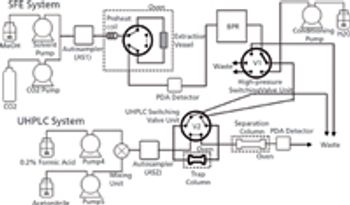
Past, present, and future developments of supercritical fluid extraction (SFE) are outlined. New vendor activity in terms of automation and hyphenation with chromatographic separations is discussed.
LCGC North America
A review of the 7th International Symposium on Packed Column SFC (SFC 2013), which was held in Boston, Massachusetts, from July 10 to 12, 2013.

Special Issues
The past and future development of analytical supercritical fluid extraction (SFE) is traced in terms of experimental strategies, applications, vendor support, and timely acceptance of the existing technology.

Special Issues
Supercritical fluid chromatography has become a viable option for the separation scientist in diverse areas, and the field now seems more adequately described as an extension of HPLC, or perhaps as "carbon dioxide–based HPLC".
Special Issues
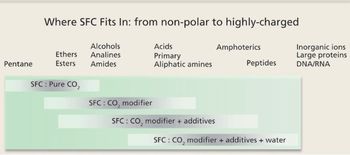
Supercritical fluid chromatography has become a viable option for the separation scientist in diverse areas, and the field now seems more adequately described as an extension of HPLC, or perhaps as "carbon dioxide–based HPLC."

LCGC North America
Food analysis, column selection, HILIC-SFC, and more

The Column
For many years, packed column supercritical fluid chromatography (pcSFC) has proven to be extremely useful for chiral chromatography at both the analytical scale and preparative level.
LCGC North America
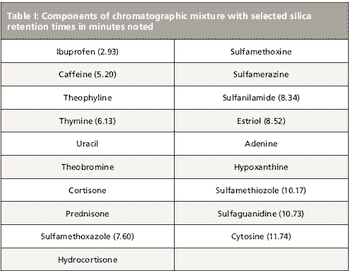
The authors compare five bonded phases with bare silica for the SFC separation of a 19-component mixture of polar analytes.

LCGC Europe
SFC is now regarded as a modern normal phase LC technique prompting a re-examination of the role of bare silica as a useful stationary phase.
The Application Notebook
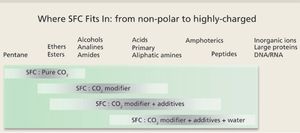
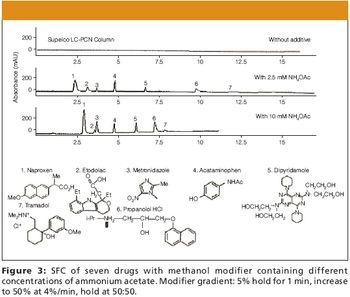
Supercritical fluid chromatography (SFC) has been practiced for approximately 50 years. SFC on packed columns for both qualitative and quantitative purposes underwent a renaissance in interest at the beginning of the 1990s when limitations of capillary SFC became obvious and important progress in composition gradient techniques for mixed mobile phases was achieved. Even with these instrumental improvements, wide acceptance of the technology was not forthcoming because the perception was that highly polar analytes were not soluble in carbon dioxide and thus were not separable. It is now apparent that the use of additives dramatically extends the range of solute polarity amenable to SFC.

LCGC North America
The author looks at both the history and the recent developments in supercritical fluid chromatography (SFC).

LCGC Europe
Supercritical Fluid Chromatography (SFC) has been practiced for approximately 50 years. SFC on packed columns for both qualitative and quantitative purposes underwent a renaissance in interest at the beginning of the 1990s when limitations of capillary SFC became obvious and important progress in composition gradient techniques for mixed mobile phases was achieved. Even with these instrumental improvements, wide acceptane of the technology was not forthcoming because the perception was that highly polar analytes were not soluble in carbon dioxide and thus were not separable. It is now apparent that the use of additives dramatically extends the range of solute polarity amenable to SFC.
January 1st 2013

November 1st 2013
December 1st 2013