
Special Issues
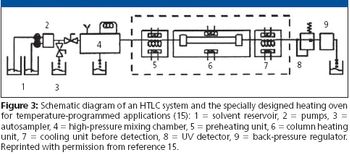
The use of high temperature is playing an increasingly important role in high performance liquid chromatography (HPLC) method development and optimization. Major advantages of high-temperature LC (HTLC) include shortened separation time, increased efficiency, and reduction in the use of organic solvent, but the accompanying decrease in mobile phase viscosity provides a lowering of column back pressure, allowing even faster separations, use of longer columns, and use of smaller particles. Here the author summarizes some of the latest findings in HTLC and addresses issues raised when columns and analytes are heated beyond the "normal" operating conditions.

