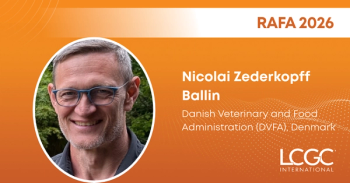
Nicolai Zederkopff explores chromatography’s role to help implement the maximum tolerable level (MTL) framework for food adulteration to translate analytical results into compliance decisions.
Elia Psillakis from the Technical University of Crete, Greece, and winner of this year’s Silver Jubilee Award from the Chromatographic Society, which will be presented at HPLC 2025, gives an update on current initiatives in green analytical chemistry.
Analytical chemistry’s success in determining the composition and quantity of matter plays a crucial role in addressing environmental challenges. However, its reliance on energy-intensive processes, non-renewable resources, and waste generation raises concerns. A paradigm shift is occurring to align analytical chemistry with sustainability science, according to Elia Psillakis.
You have stated that there is often confusion between the terms sustainability and circularity in analytical chemistry. Can you explain this difference and why it is important?
Sustainability is a term that often confuses; it has been defined in many ways and used in various contexts to refer to different aspects (1). This is because sustainability is a normative concept, tied to what people think is important and what should be done about it, an outlook that varies across people, time, and location. Our contemporary understanding of sustainability is linked to the concept of the “triple bottom line”, which balances three interconnected pillars: economic, social, and environmental. Sustainability is therefore not just about efficiently using resources and reducing waste; it’s also about ensuring economic stability and fostering social well-being (1).
In practice, sustainability is often confused with circularity, and “more circular” is frequently interpreted as “more sustainable.” While the two concepts share some common ground, they do not always align. Circularity is mostly focused on minimizing waste and keeping materials in use for as long as possible, but that doesn’t necessarily mean it considers all three dimensions of sustainability. For example, the circular analytical chemistry framework focuses on the environmental dimension and integrates strong economic considerations (2). However, the social aspect, while important, is not so pronounced.
Although sustainability and circularity do not always align, it is important to note that they are deeply interconnected. Sustainability drives the progress toward more circular practices, with innovation serving as a bridge between the two. At the same time, adopting circular principles can act as a stepping stone toward achieving broader sustainability goals (1).
What are the main challenges in transitioning separation processes from a linear “take-make-dispose” model to a circular analytical chemistry (CAC) framework? Can you illustrate this with a practical example?
Two main challenges are hindering the transition from the linear “take-make-dispose” model to a circular approach (2). The first challenge is the lack of a clear direction toward greener and more circular practices, which leads to unsustainable pressures on the environment. There is still a strong focus on the performance of products (such as faster analyses, higher sensitivity, and better precision), while sustainability factors (such as resource efficiency of these products and what happens to materials once they’re no longer useful) are rarely taken into consideration. This narrow view keeps us locked in a linear mindset, resulting in more waste and greater environmental pressure.
The second challenge is coordination failure within the field of analytical chemistry. Circular analytical chemistry relies on the collaboration of all stakeholders (including manufacturers, researchers, companies, routine labs, and policymakers) embracing circular principles and working together. However, analytical chemistry remains a traditional and conservative field, with limited cooperation between key players like industry and academia. This disconnect makes it challenging to transition to circular processes, such as recycling or resource recovery, which demand far more cooperation than conventional linear methods. Real progress toward circularity (and sustainability) will only happen when all actors find common ground, align their goals, and actively collaborate to tackle shared challenges. Breaking down silos and building bridges is crucial to accelerate the shift toward a waste-free and resource-efficient sector. Such collaborative efforts will not only streamline innovation but also ensure that sustainable practices are widely adopted and effectively implemented.
How can separation scientists adapt traditional sample preparation techniques to align with the principles of green sample preparation (GSP), particularly to reduce energy consumption?
Adapting traditional sample preparation techniques to the principles of green sample preparation (GSP) involves optimizing energy efficiency while maintaining analytical quality. A key strategy to achieve this is maximizing sample throughput, which also translates to lower exposure risks and lower analysis costs. This can be achieved in four primary ways: (i) accelerating the sample preparation step, (ii) treating several samples in parallel, (iii) automating sample preparation, and (iv) integrating steps.
One effective approach to accelerate mass transfer during sample preparation is the application of vortex mixing or assisting fields such as ultrasound and microwaves. These approaches enhance extraction efficiency and speed up mass transfer, all while consuming significantly less energy compared to traditional heating methods like Soxhlet extraction. Such systems generally apply to miniaturized sample preparation that has the additional benefits of minimizing sample size as well as solvent and reagent consumption.
Parallel processing of multiple samples is another type of miniaturized system and an impactful strategy. In this case, long preparation times become less of a limitation because handling many samples simultaneously increases overall throughput and reduces the energy consumed per sample.
The third approach of automation not only improves efficiency but also aligns perfectly with the principles of GSP. Automated systems save time, lower the consumption of reagents and solvents, and consequently reduce waste generation. In addition, automation minimizes human intervention, and as such, significantly lowers the risks of handling errors, operator exposure to hazardous chemicals, and accidents in the laboratory.
Finally, traditional sample preparation methods are often multi-step and time-consuming, which can lead to material loss and increased consumption of energy and chemicals. They also tend to compromise the precision and accuracy of analyses, particularly when dealing with complex samples. Streamlining these processes by integrating multiple preparation steps into a single, continuous workflow simplifies operations while cutting down on resource use and waste production.
In what ways do current analytical practices reflect a weak sustainability model, and what would a shift toward strong sustainability look like in practical terms?
Analytical chemistry largely operates under the weak sustainability model. This assumes that natural resources can be consumed, and waste can be generated as long as technological progress and economic growth compensate for the environmental damage. In this model, societal needs are typically addressed through increased economic opportunities or advancements in technology, with minimal consideration for the long-term impacts on natural ecosystems. Strong sustainability, on the other hand, acknowledges the existence of ecological limits, carrying capacities, and planetary boundaries. It emphasizes practices and policies aimed at restoring and regenerating natural capital, challenging the notion that economic growth alone can resolve environmental issues.
Achieving strong sustainability in analytical chemistry would require a fundamental shift away from current unsustainable practices toward disruptive innovations that prioritize nature conservation in its purest form. Although the idea of strong sustainability may seem idealistic, it serves as an important vision that can drive the field of analytical chemistry beyond incremental technological improvements. It pushes for systemic change, encouraging the development of methods and technologies that not only minimize environmental impact but also actively contribute to ecological restoration and resilience (1).
What are the main barriers preventing laboratory innovations in sustainable analytical methods from being commercialized, and how might partnerships with industry help overcome these challenges?
Innovation is a powerful catalyst for progress toward sustainability, and analytical chemistry holds immense potential for it. However, most of the innovation happens within the industry, while groundbreaking discoveries from research teams rarely make it to market. Researchers often prioritize publishing their inventions over pursuing commercialization pathways. As a result, promising green analytical methods remain confined to academia, disconnected from real-world practice where they could drive meaningful change.
Bridging this gap requires a fundamental shift in mindset. Researchers should be encouraged and trained to think entrepreneurially (2). This means identifying the commercialization potential of their innovations and understanding the steps required to bring them to the market. Equally important is the establishment of strong university–industry partnerships to drive the development of successful products. Such collaborations align academic expertise with market needs, and will unlock the true innovation potential of analytical chemistry.
What role should regulatory agencies play in driving the adoption of sustainable practices, and how can outdated methods be efficiently phased out in favor of greener alternatives?
First, it is important to frame the problem. Within the framework of a IUPAC project, we recently reported the greenness scores of 174 standard methods and their 332 sub-method variations from CEN, ISO, and Pharmacopoeias (3). The widely adopted AGREEprep metric was applied, and results revealed a poor greenness performance: 67% of the methods scored below 0.2 on the AGREEprep scale, where 1 represents the highest possible score. These findings demonstrated that many official methods still rely on resource-intensive and outdated techniques that score poorly on key greenness criteria. They also highlighted the urgent need to update standard methods by including contemporary and mature analytical methods.
Regulatory agencies have a critical role to play in this transformation. They should assess the environmental impact of existing standard methods and establish clear timelines for phasing out those that score low on green metrics. Integrating metrics into method validation and approval processes would ensure that greener practices are not just recommended but required for compliance.
Phasing out standard methods is a long process and will affect routine laboratories. To facilitate this transition, regulatory agencies should provide laboratories with technical guidance and support to adopt the new methods. Financial incentives for early adopters, such as tax benefits, grants, or reduced regulatory fees, can serve as powerful motivators for change.
What is the “rebound effect” in green analytical chemistry?
The rebound effect in green analytical chemistry refers to situations where efforts to reduce environmental impact lead to unintended consequences that offset or even negate the intended benefits. Let’s take, for example, the case of a novel, low-cost microextraction method that uses minimal solvents and energy. Initially, this seems like a green breakthrough. However, because it is cheap and accessible, laboratories might perform significantly more extractions than before, increasing the total volume of chemicals used and waste generated, ultimately diminishing the environmental benefits of the method itself.
The same may alsο apply to automation in analysis. While automation in analytical chemistry saves time and enhances efficiency, it can also lead to increased and potentially unnecessary analyses. The capability to process large volumes of samples with minimal human intervention may result in over-testing, where analyses are performed more frequently than necessary simply because the technology allows it. This can lead to increased
To mitigate these issues, laboratories can implement strategies such as optimizing testing protocols to avoid redundant analyses, use predictive analytics to identify when tests are truly necessary, and employ smart data management systems to ensure that only necessary data is collected and analyzed. Standard operating procedures must also include sustainability checkpoints; perhaps the most important point is to train laboratory personnel on the implications of the rebound effect and encourage a mindful laboratory culture where resource consumption is actively monitored.
References
(1) Psillakis, E. Towards Sustainable Analytical Chemistry. TrAC Trends Anal. Chem. 2025, Under review.
(2) Psillakis E.; Pena-Pereira F. The Twelve Goals of Circular Analytical Chemistry. TrAC Trends Anal. Chem. 2025, 175, 117686. DOI: 10.1098/rsos.21200
(3) Benedé, J. L.; Cagliero, C.; Nemutlu, E. Greenness Assessment of 174 CEN, ISO, and Pharmacopoeia Standard Methods and Their Sub-methods Used for Environmental, Food, Trace Element and Pharmaceutical Analyses. Adv. Sample Prep.2025, 14, 100180. DOI: 10.1016/j.sampre.2025.100180
Elia Psillakis is full professor in water chemistry at the School of Chemical and Environmental Engineering, Technical University of Crete. She received a Fulbright Award and used it at Caltech, USA in 2007 and in 2025, she was awarded the Silver Jubilee Medal from The Chromatographic Society. Her work includes six book chapters, 100+ ISI journal publications, 10,000+ citations (h-index = 52), and six “Top Cited Article” awards. She is Editor-in-Chief of Advances in Sample Preparation (Els
evier) and leads the Sample Preparation Study Group of EuChemS-DAC. She founded ExtraTECH Analytical Solutions and has served as Deputy Rector of Academic Affairs at the Technical University of Crete.
over 1 year ago
HPLC 2025 Preview: Columns, Capillaries, and Chaosover 1 year ago
HPLC 2025 Preview: HPLC 2025 Hits Brugesover 1 year ago
HPLC 2025 Preview: On The Road With Your Chromatograph?over 1 year ago
HPLC 2025 Preview: Boosting the Separation Power of LC×LCover 1 year ago
HPLC 2025 Preview: Fundamentally Speaking (Part 2)over 1 year ago
HPLC 2025 Preview: Fundamentally Speaking (Part 1)