
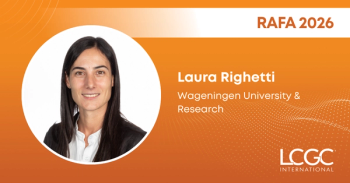
Laura Righetti explains why quantification, not instrumentation, still keeps mass spectrometry imaging (MSI) out of routine food safety testing.

Kate Jones is the Associate Editorial Director at LCGC International/The Column, MJH Life Sciences.
Laura Righetti explains why quantification, not instrumentation, still keeps mass spectrometry imaging (MSI) out of routine food safety testing.
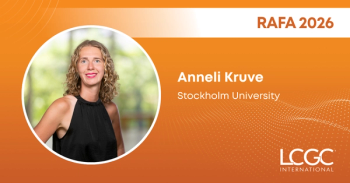
Anneli Kruve reports that toxicity predictions from MS2-derived molecular fingerprints outperform spectral-similarity methods in nontarget screening of food.

Kinjal Bhatt and Ina Varfaj redefine career success around energizing work and personal balance, moving past publications and promotions.
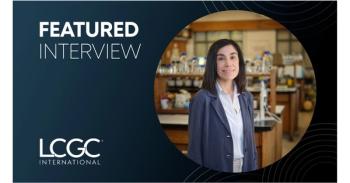
Ana Rodríguez-Bernaldo de Quirós explains how non-targeted GC–MS reveals complex chemical mixtures in bioplastic food packaging, raising safety questions.
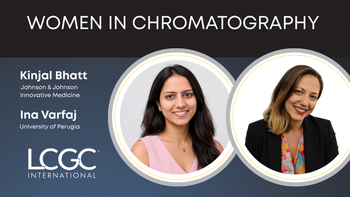
Kinjal Bhatt says belonging comes from team culture, not headcount, while Ina Varfaj's goal as her lab's only woman is making sure she isn't the last.

Kinjal Bhatt and Ina Varfaj call AI a chromatography equalizer only if training and access keep pace, framing the risk as implementation, not technology.
Kinjal Bhatt would expose early-career scientists to the field sooner, while Ina Varfaj says a broken chromatography column taught her failure is normal.
Kinjal Bhatt and Ina Varfaj describe imposter syndrome fading through repeated exposure and conference talk rather than a single breakthrough moment.

Waters' Erin Chambers says combining column chemistry and particle-physics innovation cut a GLP-1 impurity profiling workflow from three hours to under one.
Analytical science's real unwritten rule is that you don't need to feel ready, and good results simply take patience.

As PFAS analysis pushes into trace-level territory, laboratories face a fast-moving mix of vast chemical scope, method fragmentation, and background contamination.
Kinjal Bhatt argues inclusion advocacy shouldn't fall on women alone, while Ina Varfaj credits sharing the load and learning to say no for avoiding burnout.
Kinjal Bhatt and Ina Varfaj trace their pull toward analytical science to a saturated chromatography peak and the moment their first chiral peaks separated.
Caroline West on supercritical fluid chromatography's advances, pharmaceutical applications, and sustainability.
Princeton Chromatography's Jeff Caldwell says SFC can now complete separations in 10–15 seconds.
Perception, not technology, remains the biggest barrier to supercritical fluid chromatography (SFC) adoption, says JASCO's Tom DePhillipo.

Erin Chambers reflects on two leadership philosophies and a personal mantra that have shaped her approach to leading teams.
Erin Chambers shares her near-term and long-term view of how artificial intelligence will shape the chromatography community.

UHPLC–MS/MS and GC×GC methods are cutting food-safety testing times while quantifying hundreds of mycotoxins and mineral oil hydrocarbons at once.
Erin Chambers connects trustworthy data to scientific confidence and describes how Waters builds regulatory readiness into development.
A two-dimensional gas chromatography-time-of-flight mass spectrometry method detects legacy pesticides and PCBs below guideline levels.
Erin Chambers outlines the signals Waters tracks when deciding where to invest R&D across GLP-1s, lipid nanoparticles, mRNA, and ADCs.
Erin Chambers explains why she views column chemistry, not hardware, as chromatography's real differentiator, citing two recent Waters launches.
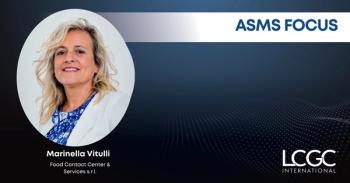
Marinella Vitulli calls formal cross-laboratory proficiency testing, not better detection technology, the field's biggest gap in NIAS analysis.
Ruling out false-positive NIAS annotations using triplicate testing and matched oven blanks rather than spectral criteria alone.
LCGC International launches "Beyond the Critical Point: Expert Insights in SFC," a topic takeover exploring SFC's science, evolution, and real-world applications.
Ranking non-intentionally added substance (NIAS) risk by consumer exposure and packaging use-case, not by hazard data alone.
Marinella Vitulli finds concentrated extracts reveal a broader contaminant profile than simulant migration tests, but filtration risks introducing cross-contamination.

A 2026 snapshot of chromatography, mass spectrometry, software, and laboratory tools advancing automation, compliance, sensitivity, and workflow efficiency
The identification-confidence framework used to rank suspect and non-intentionally added substance (NIAS) detections is discussed.
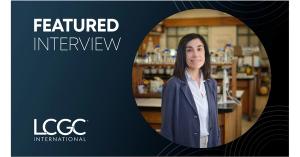
Published: October 5th 2026 | Updated: October 9th 2026

April 6th 2022
August 12th 2026


