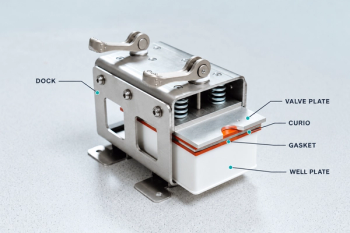
Quantera Analytical’s Terry Bates discusses parallel headspace extraction for gas chromatography-mass spectrometry (GC–MS) and direct analysis in real time–mass spectrometry (DART–MS) analysis.
High-performance liquid chromatography–tandem mass spectrometry (HPLC-MS/MS) was used in a reverse triiodothyronine (rT3) test to separate canine hypothyroidism from illness.
Figuring out whether a dog has an underactive thyroid is still tricky. Low levels of the main thyroid hormone thyroxine (tT4) in the blood can point to the condition, but they also show up often in dogs that are sick with something else entirely, since illness elsewhere in the body can temporarily lower thyroid hormone levels. Checking additional hormones such as thyrotropin (TSH) and free thyroxine (fT4) can help, but vets still find it hard to tell the two situations apart. In people, doctors have suggested measuring an inactive by-product of the thyroid hormone reverse triiodothyronine (rT3) to help separate a true thyroid problem from these illness-related changes. So far, however, no studies have looked at rT3 levels in dogs with either condition.
To fill this gap, researchers developed and checked a laboratory test, based on high-performance liquid chromatography–tandem mass spectrometry (HPLC-MS/MS), that measures rT3 in dogs. They also worked out the normal range for healthy dogs and tested whether rT3 could help vets tell an underactive thyroid apart from illness-related drops in thyroid hormone. A paper based on their work was published in the journal PLOS One.1
An underactive thyroid is one of the most common hormone problems in dogs, but it's also one of the conditions vets most often diagnose by mistake. This happens because dogs are frequently put on thyroid medication based on a single low thyroid hormone reading, even when there are no symptoms or other test results pointing to the disease.2,3Relying on that one hormone reading is risky, because levels are low not only in dogs with thyroid disease but also in roughly a third to a half of dogs that are sick with something else.4-6
The researchers measured rT3 in three groups of dogs: healthy dogs (n = 47), dogs with an underactive thyroid (n = 18), and dogs whose thyroid hormone levels had dropped because they were sick with something else (n = 23). They used the healthy adult dogs to work out what a normal rT3 level would look like and determined that it would fall within a range of ranged from 113 to 439 pg/mL.1
Dogs were counted as having an underactive thyroid if they showed typical symptoms, had low levels of the main thyroid hormone and high levels of the hormone that tells the thyroid to work harder, and got better after being given thyroid hormone medication. The "sick with something else" group included dogs that had a moderate to serious illness and low thyroid hormone levels but no signs of a thyroid problem. Finally, the researchers used a statistical method to compare how well fT3 and the established "free" thyroid hormone test could tell these two groups apart.1
Dogs with an underactive thyroid had far lower rT3 levels than the other two groups. Their typical level was just 2.5 pg/mL, compared with 229 pg/mL in dogs that were sick with something else and 281 pg/mL in healthy dogs.1
The researchers found that rT3 turned out to be very good at telling an underactive thyroid apart from other illnesses, and it did slightly better than the established "free" thyroid hormone test. How accurate it was depended on the cutoff used. With a lower cutoff, it never mistook a dog that was sick with something else for a thyroid case, but it missed about 1 in 6 dogs that truly had the condition. With a slightly higher cutoff, it caught every dog with an underactive thyroid but wrongly flagged about 1 in 6 of the dogs that had another illness. When the bottom of the normal range was used as the cutoff, it correctly identified about 78% of thyroid cases and 91% of the dogs that had another illness.1
“The establishment of a reference interval for rT3,” write the authors of the paper,1 “will enable future interpretation of rT3 values in dogs. rT3 represents a valuable diagnostic parameter for differentiating canine hypothyroidism from NTIS.”
Read More on Similar Topics
References