
GC–MS Reveals Hidden Chemicals in Bioplastic Food Packaging
Published: | Updated:
Ana Rodríguez-Bernaldo de Quirós explains how non-targeted GC–MS reveals complex chemical mixtures in bioplastic food packaging, raising safety questions.
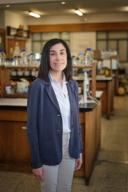
Ana Rodríguez-Bernaldo de Quirós is full professor of nutrition and food science at the University of Santiago de Compostela (USC). She received her PhD degree in pharmacy from University of Santiago de Compostela. Her research activity is focused on the chemical safety of food contact materials, active food packaging, and food analysis. In particular: (i) development of analytical methods for the determination of monomers, additives, etc. used in the manufacture of food contact materials as well as the development of analytical methodologies to identify non intentionally added substances (NIAS) in food packaging materials, (ii), exposure assessment to chemicals transferred from food contact materials; (iii) study of migration kinetics (determination of partition and diffusion coefficients of model migrants in food and food simulants), (iv) development and evaluation of active food packaging; and (v) development of analytical methodologies for the determination of food components and bioactive compounds.
Ana Rodríguez-Bernaldo de Quirós explains how non-targeted GC–MS reveals complex chemical mixtures in bioplastic food packaging, raising safety questions.
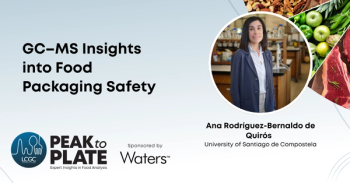
Ana Rodríguez-Bernaldo de Quirós of the University of Santiago de Compostela discusses how non-targeted gas chromatography–mass spectrometry (GC–MS) can reveal complex chemical mixtures in bioplastic food packaging, raising important safety questions and concerns for consumers.
Published: October 5th 2026 | Updated: October 9th 2026
Published: October 5th 2026 | Updated: October 9th 2026