


Temperature is frequently employed to enhance analytical extractions, especially with solid samples or volatile analytes. Using temperature to enhance analytical extractions continues today with more recently developed techniques, which we explore.

"Sample Prep Perspectives" editor Douglas E. Raynie is a Department Head and Associate Professor at South Dakota State University. His research interests include green chemistry, alternative solvents, sample preparation, high-resolution chromatography, and bioprocessing in supercritical fluids. He earned his PhD in 1990 at Brigham Young University under the direction of Milton L. Lee. Raynie is a member of LCGC's editorial advisory board. Direct correspondence about this column via e-mail to LCGCedit@mjhlifesciences.com.
Temperature is frequently employed to enhance analytical extractions, especially with solid samples or volatile analytes. Using temperature to enhance analytical extractions continues today with more recently developed techniques, which we explore.

Douglas E. Raynie explores formal and informal training opportunities that may be available to educate all chemists in the fundamentals of necessary laboratory sample preparation skills.

LCGC North America
This selection of influential recent papers on chromatographic sample preparation gives us a sense of important developments.

LCGC North America
To better understand modern sample preparation techniques-such as ultrasound-assisted extraction, microwave-assisted extraction, and pressurized solvent extraction-we should look at the lessons these methods took from Soxhlet extraction.
LCGC North America
Our annual report of sample preparation instrumentation, supplies, and accessories for gas and liquid chromatography

LCGC Europe
This yearly report on new products introduced since March 2018 covers sample preparation instrumentation, supplies, and accessories.
LCGC Asia Pacific
This yearly report on new products introduced since March 2018 covers sample preparation instrumentation, supplies, and accessories.

LCGC Europe
Solid-phase microextraction (SPME) was introduced nearly 30 years ago and since that time has matured into a widely used tool in the arsenal of sample preparation techniques. Simultaneously, it has spawned a host of related techniques where sorbent coatings are placed on stir bars, magnetic particles, vial walls, and so on. Over the past few years, several advances in SPME have been developed, including increasing the sorbent surface area available for extraction, accommodating direct analysis by mass spectrometry (MS), and sorbent overcoating to resist fouling by sugars, lipids, and other macromolecules present in some sample types. These advances are discussed in this month’s instalment. The use of SPME for microsampling of biological systems, so-called bio-SPME, will be the focus of Part 2.

LCGC Europe
Confusion exists on the quantitative nature of headspace sampling, because it is an equilibrium-based technique when done in the static mode, but not necessarily in the dynamic mode. To aggravate matters further, the concentrations of headspace compounds in common applications, like foods, flavours, or petroleum distillates, can easily vary by an order of magnitude or more. Thus, what defines quantitative may depend largely on the goals of the analysis. This month we’ll take a look at headspace sampling and its quantitative nature.

LCGC Europe
As this is the final “Sample Prep Perspectives” column of the year, it is fitting to assess the state of the field by taking a look back and a look forward.

LCGC North America
We assess the state of the field, first looking back at developments presented at conferences this year, reader questions, and the passing of a pioneer in solid-phase extraction. Then, we look to the future of sample preparation.
LCGC North America
Blanks are important in the pursuits of quality control and robust quantitative analytical methods, but many analysts don’t fully understand their value, or how to use them correctly.

LCGC Europe
Too often, analysts follow prescribed methods, including the processing of “blanks”, without fully understanding the rationale behind the various steps. This month we’ll look at the types of blanks used in an analytical procedure and why they are used. We will focus on those defined by U.S. regulatory agencies.

LCGC Asia Pacific
This yearly report on new products introduced at Pittcon (or in the preceding year) covers sample preparation instrumentation, supplies, and accessories.

LCGC North America
Our yearly report on new products covers sample preparation instrumentation, supplies, and accessories. New sample preparation technologies introduced in the past year, while not necessarily disruptive, take giant leaps in that direction.
LCGC Europe
This yearly report on new products introduced at Pittcon (or in the preceding year) covers sample preparation instrumentation, supplies, and accessories.
LCGC North America
A look at recent advances in SPME, such as increasing the sorbent surface area available for extraction, accommodating direct analysis by mass spectrometry, and sorbent overcoating to resist fouling by sugars and lipids
LCGC Europe
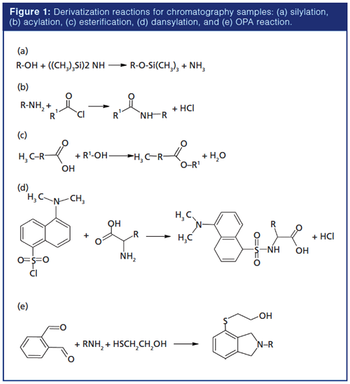
During the developmental stages of chromatography, the use of sample derivatization was prevalent either to render difficult-to-separate analytes ready for chromatography or to improve analyte detectability. As chromatography techniques advanced, including detection, the need for derivatization was less pronounced. Today, there is a resurgence of interest in derivatization schemes; however, the new generation of separation scientists is not as well-versed in these reactions. Some of this resurgence is for newer purposes, such as combining two or more derivatizations for the analysis of multiple compound classes, or to develop greener approaches. In this month’s instalment, we explain the use of chemical derivatization in the separation sciences, generally, and in sample preparation specifically.
LCGC North America
There is a resurgence of interest in chemical derivatization schemes in separation science, particularly in sample preparation. Here’s why.

LCGC Europe
Traditional extraction methods for food samples, such as liquid–liquid extraction and Soxhlet extraction, are often time-consuming and require large amounts of organic solvents. Therefore, one of the objectives of analytical food safety studies currently has been the development of new extraction techniques that can improve the accuracy and precision of analytical results and simplify the analytical procedure.
LCGC North America
Incremental sampling methodology laboratory processing is used to produce an appropriately sized subsample that has the analytes of interest at the same concentration as the large incremental sample collected in the field. The end goal is to produce results that represent the conditions at the site and facilitate good decisions.

LCGC Europe
In this extended special feature to celebrate the 30th anniversary edition of LCGC Europe, leading figures from the separation science community explore contemporary trends in separation science and identify possible future developments. We asked key opinion leaders in the field to discuss the current state of the art in sample preparation.

LCGC Europe
Perhaps the largest source of error with sampling and sample preparation, especially with solid and semisolid samples, is the sample heterogeneity. Generally, sample heterogeneity is managed by sample homogenization, such as grinding and mixing, as well as use of an appropriately large sample size. Incremental sampling methodology (ISM) involves structured composite sampling and a processing method to create an unbiased estimate of the mean concentration of soil contaminants. Hence, ISM is emerging as a preferred methodology for conducting field environmental sampling. In this month’s instalment of “Sample Preparation Perspectives”, we describe the application of ISM to laboratory subsampling protocols.

LCGC Asia Pacific
This yearly report on new products introduced at Pittcon 2017 (or in the preceding year) covers sample preparation instrumentation, supplies, and accessories.
LCGC North America
CAE is a versatile sample preparation tool for aqueous samples.
LCGC Europe
This yearly report on new products introduced at Pittcon 2017 (or in the preceding year) covers sample preparation instrumentation, supplies, and accessories.
LCGC North America
This yearly report on new products introduced at Pittcon 2017 (or in the preceding year) covers sample preparation instrumentation, supplies, and accessories.
LCGC North America
Traditional extraction methods for food samples, such as liquid-liquid extraction and Soxhlet extraction, are often time-consuming and require large amounts of organic solvents. Therefore, one of the objectives of analytical food safety studies currently has been the development of new extraction techniques that can improve the accuracy and precision of analytical results and simplify the analytical procedure.
LCGC North America
Blood is perhaps the most widely used sample fluid in bioanalysis. Dried blood spots (DBS) have been used with clinical samples for over 50 years but are recently seeing a resurgence of interest. DBS hold several advantages associated with the use of small sample sizes obtained via finger pricks, reduction biohazard, and more. In the previous installment, we gave an overview of microsampling in bioanalysis. This month, we will dig deeper into bioanalysis using DBS.

LCGC Europe
Blood is perhaps the most widely used sample fluid in bioanalysis. Dried blood spot (DBS) sampling has been used in clinical applications for more than 50 years, but it is recently seeing a resurgence of interest. DBS sampling holds several advantages associated with the use of small sample sizes obtained via finger pricks, including simplicity and biohazard reduction. In the previous instalment, we gave an overview of microsampling in bioanalysis (1). This month, we dig deeper into bioanalysis using DBS sampling.