

LCGC Europe
This instalment of “Questions of Quality” looks at problems with an operational liquid chromatograph to see if they can be picked up in the performance qualification (PQ) or prevented in the operational qualification (OQ).
LCGC Europe
This instalment of “Questions of Quality” looks at problems with an operational liquid chromatograph to see if they can be picked up in the performance qualification (PQ) or prevented in the operational qualification (OQ).
LCGC Europe
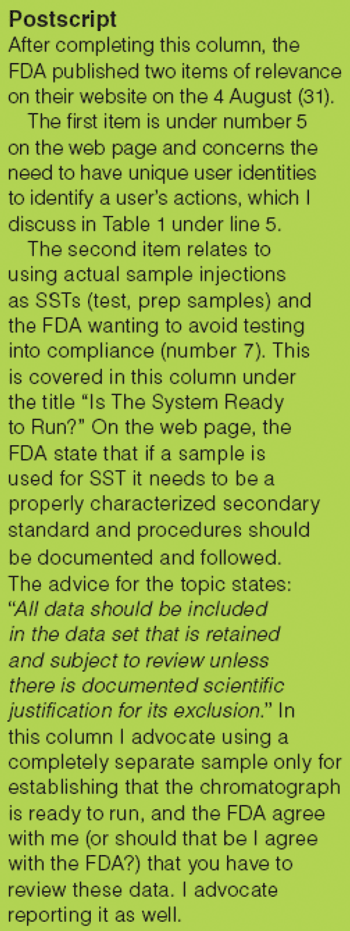
Chromatography data systems (CDSs) have had a starring role in many regulatory citations involving falsification and fraud in analytical laboratories regulated by Good Manufacturing Practices (GMP). In this instalment of "Questions of Quality" we will examine the citations and identify the technical and procedural controls required to ensure data integrity within these systems. Although focused primarily on the pharmaceutical industry, the principles described here are applicable to all laboratories working to established quality standards.

LCGC Europe
The concluding part of the article from last month's "Question of Quality" on what "complete data" actually means in practice.

LCGC Europe
This article will explore what is meant by "complete data" in the context of a chromatography data system and, with an analysis of FDA 483 citations, explore the problems when a laboratory fails to understand this phrase.

LCGC Europe
Answers to common questions about operational qualification software.
LCGC Europe
Written procedures used by trained staff are the basis for all quality systems but there are many ways of writing a procedure. Are you getting it write?
LCGC Europe
Mistakes or fat finger moments are part of human nature but where is the dividing line between this and falsification and fraud?
LCGC Europe
The results of a recent survery on stationary phases used in high performance liquid chromatography (HPLC) are revealed.
LCGC Europe
A look at the role of system suitability tests (SSTs) during performance qualification (PQ).
LCGC Europe
How will the new revision of EU GMP Annex 11 on Computerized Systems and Chapter 4 on Documentation affect chromatographers?
LCGC Europe
The concluding part of the series on the role of system suitability tests in the pharmaceutical industry.
LCGC Europe
There is more to using and interpreting certificates for chromatography standards than meets the eye
LCGC Europe
There is a new FDA Commissioner who wants a "strong FDA". Chromatographers must be prepared to be compliant and remain compliant - or else!

LCGC Europe
United States Pharmacopeia (USP) general chapter 1058 on analytical instrument qualification (AIQ) has finally become official and was released in August 2008 in the first supplement to the USP XXXI.1 This column reviews AIQ and discusses the impact it will have in the regulated chromatography laboratory.

LCGC Europe
This column discusses the similarities and differences between the validation approaches for analytical methods for QC product analysis and bioanalysis.
LCGC Europe
The regulatory world and associated guidance documents within the pharmaceutical industry is changing rapidly. This column gives an overview of what's happened since the start of the year.

LCGC Europe
You may work in a chromatography laboratory to quality standards but do you work to Good Laboratory Practice? Probably not...
LCGC Europe
The four eyes approach is a cornerstone of any quality system (GMP, GLP or ISO 17025): a first person performs a task and a second person checks it.
LCGC Europe
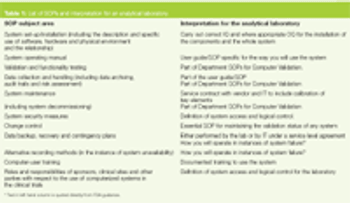
Information from guidance documents used in clinical investigations can be very useful to help meet FDA regulations regarding computer security in analytical laboratories.

LCGC Europe
Users need to understand not only the operation of the computer system as required by their access privileges, but also the ethics and integrity required operating under any of the GMP or GLP quality systems.

LCGC Europe
The fundamental aim of any computerized system validation should be to define its intended use and then test it to demonstrate that it complies with specification.

LCGC Europe
The best parts of the GAMP laboratory system GPG are the life cycle models for both development and implementation of computerized laboratory systems.

LCGC Europe
Part 2 of the column explores using the right balance for the right job in the right way.

LCGC Europe
The implementation and validation of a new site-wide chromatography data system for a major active pharmaceutical ingredient custom manufacturer provided the opportunity to map and optimize the GMP and ISO business processes to use electronic signatures effectively. This article describes the process optimization and how it integrates with the validation activities of the system. This overall approach provides substantial business benefits from the use of electronic signatures as evidenced by the savings resulting from process improvement and by the fact that the non-GMP laboratories implemented a similar process to analyse and approve results electronically.
LCGC Europe
Bob McDowall stresses the importance of using accurate and precise time and date stamps to ensure the integrity of the data and results generated by computerized systems in any chromatography laboratory.
LCGC Europe
In the welcome return of this column, Bob McDowall revisits the evolving topic of 21 CFR 11 compliance, as it applies to chromatographers. He examines the FDA's activities in 2003 and outlines the current status of its regulations over, and guidance for, electronic records issues.