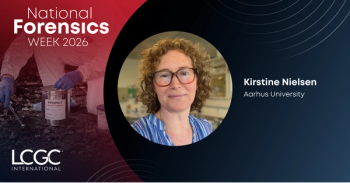
Kirstine Nielsen of Aarhus University (Denmark) discusses how targeted metabolomics ratios helped build a robust bloodstain time-since-deposition tool.
Join leading researchers and industry experts for an in-depth session on emerging contaminants, PFAS detection, and non-target analysis strategies shaping the future of environmental testing.
MOG am: Environmental: Non-Target Analysis and Emerging Contaminants
Monday, June 1, beginning at 8:30 am in Room 6CF.
Join leading researchers and industry experts for an in-depth session on emerging contaminants, per- and polyfluoroalkyl substances (PFAS) detection, and non-target analysis strategies shaping the future of environmental testing.
This session features cutting-edge research on:
Presentations from experts will highlight the newest analytical workflows and technologies driving environmental science forward.
The session starts at 8:30 am with From Lab to Legislation: A Harmonized Experimental Approach to Drinking Water Treatment Assessments for Plant Protection Products, presented by Michael Kubicki of Bayer AG (Monheim, Germany).
At 8:50 am, Sheher Mohsin of Beyond Spectral Peaks (Barrington, IL) and Yale University (New Haven, CT) discusses Leveraging Ion Mobility for PFAS Non-Targeted Analysis using FluoroMatch IM 2.0 and a Collision Cross Section (CCS) Atlas.
Christine Fisher (U.S. Food & Drug Administration, College Park, MD) presents Improved Non-Targeted Coverage of PFAS Using Mass Defect Informed Data-Dependent Analysis at 9:10 am.
At 9:50 am, Spatial Detection of Polystyrene Plastics in Full-Body Murine Tissue with MALDI-TIMS-MSI will be presented by Karina A. Vargas (University of California-Davis, Davis, CA).
The session concludes at 10:10 am with Uncovering PFAS Bioaccumulation in Seal Livers: Insights from Suspect Screening and Nontarget Analysis Using HPLC-IMS-QTOF-MS; presented by Yanan Chen of Carnegie Mellon University (Pittsburgh, PA).