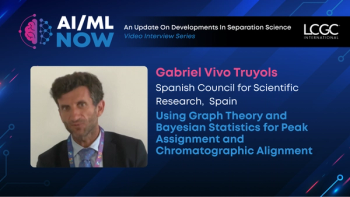
Gabriel Vivó-Truyols from the Spanish Council for Scientific Research, Madrid, Spain. discusses his work on using graph theory and Bayesian statistics for peak assignment and chromatographic alignment.
Gabriel Vivó-Truyols outlines the benefits and challenges of combining graph theory with Bayesian statistics to automate peak assignment and alignment.
Inn this LCGC International video for the AI/ML Now interview series, Gabriel Vivó-Truyols from the Spanish Council for Scientific Research, Madrid, Spain. discusses his work on using graph theory and Bayesian statistics for peak assignment and chromatographic alignment.1 Matching peaks across chromatograms is a key step in data processing, but traditional alignment and peak-matching methods are deterministic and commit to a single answer, even when several assignments are plausible. Vivó-Truyols explains why he brought peak assignment and alignment together in one graph-theory framework, and how a Bayesian treatment of multiple possible assignments can make the results more robust. He also talks about the main bottlenecks, and how practical it would be to bring the approach into commercial chromatography software for semi-automated data curation in routine labs.
In the interview, he answered the following questions:
• How does the Bayesian treatment of multiple possible assignments improve robustness compared with traditional deterministic alignment and peak matching methods?
• What are the main bottlenecks of this approach
Reference