Market Trends and Analysis: Water Analysis and Testing Glenn Cudiamat reports on the vast water analysis market and looks at worldwide demand for laboratory separation techniques within the water testing industry. Separation of Complex Peptide Samples Using Optimized Column Technology and 1D-LC Conditions Sebastiaan Eeltink, Bas Dolman, Karsten Dekker, Fraser McLeod and Remco Swart Diastereoselective Separation of Fenvalerate by Supercritical Fluid Chromatography with Tandem Columns Jennifer Lefler and Rui Chen News All the news for September 2008. Incognito: Turn On, Tune In, Outsource… With many laboratories closing or downsizing in preference for outsourcing work to offshore territories, Incognito highlights some of the shortfalls to be expected. Q&Q The Column's Alasdair Matheson spoke to Rohan Thakur from thermo Fisher Scientific about the company's rationale behind developing the TSQ Vantage — a triple quadrupole mass spectrometer — for high sensitivity bioanalysis.
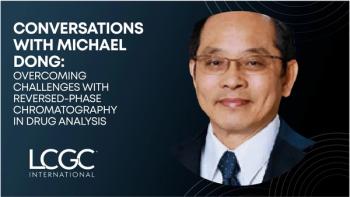
In this fifth part of " Conversations with Michael Dong," a series on fundamentals of HPLC in pharmaceutical analysis, LCGC International’s "Perspectives in HPLC" column editor discusses how to overcome challenges with reversed-phase chromatography in drug analysis.
This week on Chromatography Online, leading experts shared practical insights with LCGC International on sustainable affinity methods, siRNA impurity profiling, nontarget screening, peptide tech transfer, and AI in separation science.
Anneli Kruve reports that toxicity predictions from MS2-derived molecular fingerprints outperform spectral-similarity methods in nontarget screening of food.
In this fourth part of " Conversations with Michael Dong," a series on fundamentals of HPLC in pharmaceutical analysis, LCGC International’s "Perspectives in HPLC" column editor explains why buffers are most often used in Mobile Phase A in high-pressure liquid chromatography of pharmaceuticals.