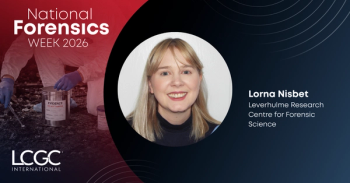
Lorna Nisbet from the Leverhulme Research Centre for Forensic Science, discusses a GC–MS. technique developed to detect anabolic-androgenic steroids in e-cigarettes seized from Scottish prisons.
Kinjal Bhatt and Ina Varfaj trace their pull toward analytical science to a saturated chromatography peak and the moment their first chiral peaks separated.
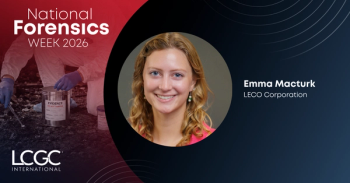
Emma Macturk from LECO Corporation explains which forensic applications benefit from GC×GC’s greater peak capacity, and when the additional separation power may only provide limited benefits.
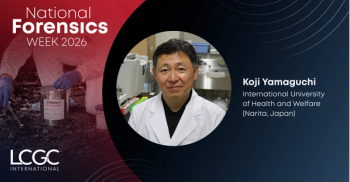
Koji Yamaguchi of the International University of Health and Welfare (Narita, Japan) discusses a novel derivatized liquid chromatography-tandem mass spectrometry (LC-MS/MS) method plus propofol glucuronide (PRG) marker which improves forensic propofol detection.
Gas chromatography-mass spectrometry (GC-MS) coupled with headspace solid-phase microextraction )HS-SPME) links cocoa variety to chocolate aroma and flavor profiles.
Kirstine Nielsen of Aarhus University (Denmark) discusses how targeted metabolomics ratios helped build a robust bloodstain time-since-deposition tool.