|Articles|December 3, 2019

Evaluating Degradation of Drug Delivery Polymers Using Advanced Polymer Chromatography (APC) with Light Scattering and Viscometry

⦁ Determine polymer properties such as molecular weight, dispersity, and branching/conformation. ⦁ How to differentiate molecular structure across the molecular weight distribution.



Related to this article

Chromatography Detects Toxins in Tea Samples
High-performance liquid chromatography-tandem mass spectroscopy (HPLC–MS/MS) chromatography reveals pyrrolizidine alkaloids (PA)/pyrrolizidine alkaloid N-oxides (PANO) toxin risks in 63 tea samples.
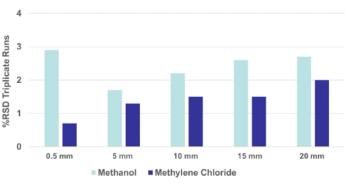
Figure 2. Split injection used to measure triplicate test of MTBE, hexane, o-xylene, and 1-methylnaphthalene comparing different solvents (methanol, methylene chloride) and column insertion distances starting with 0.5 mm, 5.0 mm, 10.0 mm, 15 mm, and 20.0 mm. Methanol had the best performance at the 5.0 mm insertion distance and methylene chloride looked slightly better at the 0.5 mm. We would still recommend not going below the 5.0 mm manufacturer recommended insertion distance.
Revisiting insertion distance for methanol and methylene chloride in GC analysis and confirming that insertion depth strongly affects response and reproducibility.