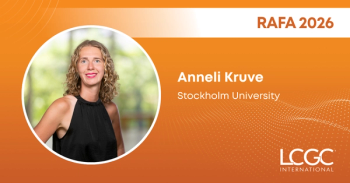
Anneli Kruve reports that toxicity predictions from MS2-derived molecular fingerprints outperform spectral-similarity methods in nontarget screening of food.
Kinjal Bhatt and Ina Varfaj describe imposter syndrome fading through repeated exposure and conference talk rather than a single breakthrough moment.
“The feeling unsure of yourself doesn't necessarily mean you are not capable.”
— Kinjal Bhatt, Senior Scientist, Johnson & Johnson Innovative Medicine
“Find a community, find a mentor, a colleague, someone else who can tell you that you're not alone in this way.”
— Ina Varfaj, Postdoctoral Researcher, University of Perugia
Studies on imposter syndrome in STEM aren't abstract to either panelist. Kinjal Bhatt and Ina Varfaj both said the feeling was familiar, though it showed up for each of them in a different form and at a different career stage. For Bhatt, it wasn't about not knowing the science, it was walking into a room and wondering whether she added any value, a voice that made her hesitate to ask questions or join conversations even when she had something to contribute. What changed it wasn't a single breakthrough but repetition: more situations, more conversations, more people, until she realized confidence doesn't arrive before you participate, it follows from participating. She still has the thought occasionally, she says, but it no longer carries the same weight. Varfaj goes back to the early years of her PhD, when she wasn't sure she belonged in the room and wasn't yet sure of her place in the scientific community. Her turning point was deliberately putting herself in uncomfortable settings—going to conferences alone and talking to experts in the field—which taught her she had something to contribute and, over time, reframed the question in her head from "do I belong here?" to "what should I learn next?" Both land on the same practical advice for anyone feeling it now: find a community, a mentor, or a colleague who can tell you honestly that you're not the only one who feels this way. Bhatt is candid that, earlier in her career, that inner voice kept her from speaking up even when she had something worth contributing, and says naming that experience out loud is part of what helps other women recognize they aren't alone in it.
To view more Women in Chromatography discussions, please click
21 days ago
Revisiting Column Insertion Distance21 days ago
A Preview of SFC Europe 2026