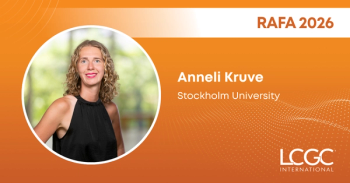
Anneli Kruve reports that toxicity predictions from MS2-derived molecular fingerprints outperform spectral-similarity methods in nontarget screening of food.
Steven Ray Wilson's AFFL LC–MS system runs thousands of injections per column, but he calls validation and standardization the field's real barrier.
Robustness and credibility are the two threads Wilson pulled on when LCGC International asked what it will take to move this kind of analysis out of the research lab and into routine, everyday use in drug discovery and high-throughput applications. He described the automatic filtration and filter flush coupled with liquid chromatography–mass spectrometry (AFFL LC–MS) system his group relies on as a column-switching setup built specifically for durability. Working with cell culture media samples, the system can handle thousands of injections without ever needing to swap out the column. Wilson credited that endurance to the system's self-cleaning features, paired with deliberate choices of mobile phase and stationary phase that let it separate out unwanted material while retaining what's needed for analysis. The result, he said, is a fully automated workflow that removes manual intervention from the process and delivers, in his words, “a lot of advantages” over conventional setups.
But Wilson was clear that the bigger obstacle to routine adoption isn't the technology itself, it's convincing the broader medical, clinical, and biological research community that the system genuinely works. That means benchmarking new methods directly against conventional approaches so the advantages are demonstrable, rather than presenting results in isolation. Just as important, he said, is testing with real samples, including the difficult, non-ideal cases that push a method to its limits, rather than a curated set of favorable ones. Wilson named validation and standardization as the two priorities that will ultimately determine whether organoid and organ-on-a-chip-based analytical methods move out of specialized research groups and into mainstream research and clinical applications—a distinction he called a very hot and important topic for the field right now.1,2
Wilson answered the following questions:
Watch the full interview here: