
LCGC UST
News|Articles|September 11, 2025

GC Gurus: Put Your Skills to the Test

Author(s)Kate Jones
Listen
0:00 / 0:00

Key Takeaways

  • Gas chromatography separates and analyzes vaporized compounds using a mobile phase and a stationary phase within a column.
  • The technique is crucial in pharmaceuticals, environmental analysis, and food safety for its ability to separate complex mixtures.
SHOW MORE

Are you ready to separate the facts from the fiction?

It's time to see if your gas chromatography know-how is on point! This quick quiz is designed to challenge. So sharpen your pipettes, double-check your injector settings, and get ready to separate the facts from the fiction. Only true GC gurus will ace it! Are you ready to separate the facts from the fiction?

Select the gas chromatography (GC) parameter that typically improves chromatographic resolution by directly increasing the number of theoretical plates.


Related to this article

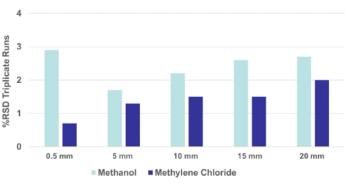
Figure 2. Split injection used to measure triplicate test of MTBE, hexane, o-xylene, and 1-methylnaphthalene comparing different solvents (methanol, methylene chloride) and column insertion distances starting with 0.5 mm, 5.0 mm, 10.0 mm, 15 mm, and 20.0 mm. Methanol had the best performance at the 5.0 mm insertion distance and methylene chloride looked slightly better at the 0.5 mm. We would still recommend not going below the 5.0 mm manufacturer recommended insertion distance.
Revisiting insertion distance for methanol and methylene chloride in GC analysis and confirming that insertion depth strongly affects response and reproducibility.