|Articles|June 12, 2020

Identifying and Quantifying Aspartate and Iso-Aspartate Isomers and Other Difficult PTMs in Proteins

CE–MS can help address limitations associated with traditional LC–MS CE–MS provides fast separations with low sample consumption and no carry over



Related to this article

Chromatography Detects Toxins in Tea Samples
High-performance liquid chromatography-tandem mass spectroscopy (HPLC–MS/MS) chromatography reveals pyrrolizidine alkaloids (PA)/pyrrolizidine alkaloid N-oxides (PANO) toxin risks in 63 tea samples.
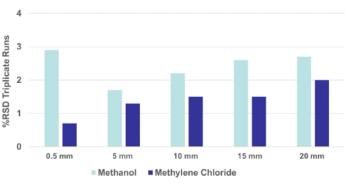
Figure 2. Split injection used to measure triplicate test of MTBE, hexane, o-xylene, and 1-methylnaphthalene comparing different solvents (methanol, methylene chloride) and column insertion distances starting with 0.5 mm, 5.0 mm, 10.0 mm, 15 mm, and 20.0 mm. Methanol had the best performance at the 5.0 mm insertion distance and methylene chloride looked slightly better at the 0.5 mm. We would still recommend not going below the 5.0 mm manufacturer recommended insertion distance.
Revisiting insertion distance for methanol and methylene chloride in GC analysis and confirming that insertion depth strongly affects response and reproducibility.