LCGC North America
WAX type columns are the industry standard analyzing a wide range of compounds with polar functional groups. The new Agilent DB-WAX Ultra Inert GC column is presented.
LCGC North America
WAX type columns are the industry standard analyzing a wide range of compounds with polar functional groups. The new Agilent DB-WAX Ultra Inert GC column is presented.
LCGC Europe
WAX type columns are the industry standard analyzing a wide range of compounds with polar functional groups. The new Agilent DB-WAX Ultra Inert GC column is presented.

LCGC Asia Pacific
PLOT columns are often used in GC analyses when it is necessary or desirable to retain one class of solutes in favour of other solutes that have little or limited interactions with the surface of the stationary phase. With a PLOT column, chromatographers can even cause lower boiling point compounds to elute well after higher boiling point compounds, thus providing better qualitative and quantitative separations for the solutes of interest.
LCGC Europe
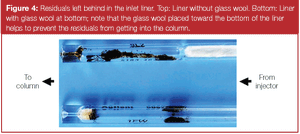
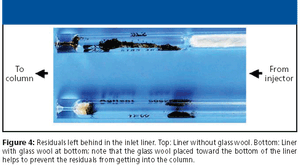
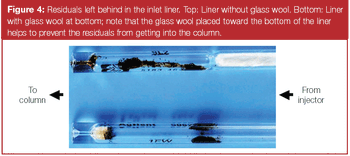
Modern gas chromatography (GC) capillary columns are rugged and forgiving but some care should be taken when handling and using these high-efficiency columns. In this instalment of "Column Watch", the authors discuss the issues surrounding avoiding column breakage, stationary phase damage and column contamination. Prolonging the life of a column by keeping an oxygen-free system, providing a cleaner sample and not exceeding the upper temperature limit of the stationary phase are highlighted in this practical discussion.
LCGC North America
In this month's issue, columnist Ron Majors and coauthors discuss the important steps in the successful production of fused-silica gas chromatography (GC) capillary columns.
LCGC North America
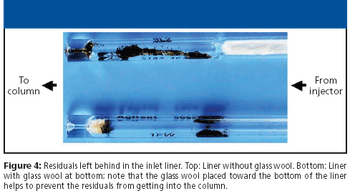
Modern gas chromatography (GC) capillary columns are rugged and forgiving but some care should be taken when handling and using these high-efficiency columns. In this installment of "Column Watch," the authors discuss the issues surrounding avoiding column breakage, stationary phase damage, and column contamination. Prolonging the life of a column by keeping an oxygen-free system, providing a cleaner sample, and not exceeding the upper temperature limit of the stationary phase are highlighted in this practical discussion.