
Webcasts
Webinar Date/Time: Tue, Sep 22, 2026 11:00 AM EDT
Webcasts
Webinar Date/Time: Tue, Sep 22, 2026 11:00 AM EDT

BrightSpec's headspace-MRR platform eliminates the need for chemical derivatization in formaldehyde quantitation achieving reproducible detection across a wide dynamic range
BrightSpec's platform achieved LODs of 3 ppm for EG and 60 ppm for DEG in PEG-400. Linearity was strong and repeatability remained under 4%.
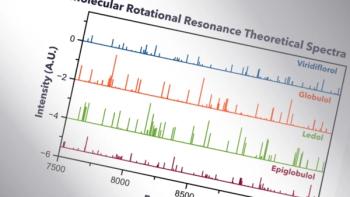
Structural misassignment risks propagating errors. MRR spectroscopy with molecular modeling discriminates viridiflorol, globulol, and stereoisomers sans reference standards.
BrightSpec's isoMRR™ platform directly detects EtO and acetaldehyde in PEG-3350, meeting USP LOQ criteria in under one minute with no sample prep
This application note demonstrates how BrightSpec's platform provides a faster, simpler alternative to GC-MS for residual solvent analysis in pharmaceutical products

Webcasts
Webinar Date/Time: Wed, Oct 15, 2025 11:00 AM EDT
Sponsored Content
Learn how MRR simplifies chiral analysis of raw materials like alaninol—no columns, no standards, and no derivatization required.
Sponsored Content
Molecular rotational resonance (MRR) spectroscopy operates in the microwave region, detecting transitions between pure rotational energy levels. Combined with adiabatic cooling, MRR produces highly selective spectra unique to each molecule’s atomic structure. Even slight changes in atomic position or mass result in distinct spectral differences, allowing MRR to directly analyze complex mixtures, including isomers, without chromatographic separation. This article presents a continuous headspace-MRR method for analyzing Class 2 residual solvents, including low-volatility solvents from Class 2 Mixture C. By evaluating solvents with diverse boiling points, the study demonstrates that MRR meets ICH and USP standards for most Class 2 and Class 3 solvents and half of Class 1 solvents.
May 26th 2026
May 26th 2026
May 26th 2026
