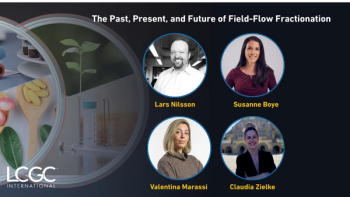
Panelists offer a realistic outlook for FFF, with miniaturization and emerging application areas seen as future directions.

Claudia Zielke is an analytical chemist with expertise in separation sciences and light scattering techniques. In 2017 she received her Ph.D. from the Department of Food Technology, Engineering and Nutrition from Lunds University in Sweden, specializing in asymmetric flow field-flow fractionation with multi-detection for the analysis of macromolecules. After her appointment as Inclusive Excellence Postdoctoral Fellow at Santa Clara University, CA, USA, she joined the Barron Lab for Innate Immune Optimization at the School of Medicine, Bioengineering at Stanford University, CA, USA. Currently, Zielke is a Research Scientist at Vaxcyte, a biopharmaceutical company in San Carlos, CA, developing novel polysaccharide and protein conjugate vaccines. She is also the Senior Managing Editor of Chromatographia, An International Journal for Separation Science by Springer Nature.
She has 14 years of experience with FFF and other flow-based separation techniques.
Panelists offer a realistic outlook for FFF, with miniaturization and emerging application areas seen as future directions.
Experts assess whether coupling with detectors such as MALS, Raman, and ICP-MS has elevated FFF from exploratory research to a decision-making tool.
Panelists agree that a shortage of trained users underpins all other barriers to FFF becoming a validated routine tool in industrial settings.
Experts examine how automation, software harmonization, and AI-assisted data analysis could lower barriers to FFF adoption and support routine use.
Panelists identify biopharma and environmental nanoplastics analysis as the most significant emerging drivers of FFF development.
From hand-built channels to commercial instruments, experts discuss the instrumentation, applications, and theory that have shaped FFF.

Field-flow fractionation (FFF), and, in particular, asymmetrical flow field-flow fractionation (AF4), is transitioning from a specialized separation technique into an application-driven analytical platform. From the perspective of the Young Scientists of FFF, we describe how advances in inline detection, data analysis, and validation are expanding AF4’s capacity to deliver size-resolved structural and compositional insights into complex systems. We highlight how this evolution enables more reliable characterization of heterogeneous and dynamically assembled materials across disciplines. We argue that realizing this potential will require deliberate choices (by the community, instrument developers, and end users) to move AF4 from niche expert knowledge to broadly trusted analytical practice.

The authors present their motivation for establishing the Young Scientists of FFF (YSFFF) initiative within the FFF community.