
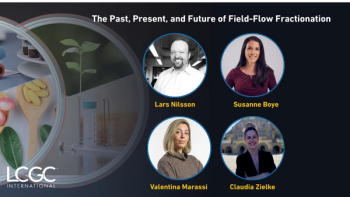
Panelists offer a realistic outlook for FFF, with miniaturization and emerging application areas seen as future directions.
Panelists offer a realistic outlook for FFF, with miniaturization and emerging application areas seen as future directions.
Experts assess whether coupling with detectors such as MALS, Raman, and ICP-MS has elevated FFF from exploratory research to a decision-making tool.
Panelists agree that a shortage of trained users underpins all other barriers to FFF becoming a validated routine tool in industrial settings.
Experts examine how automation, software harmonization, and AI-assisted data analysis could lower barriers to FFF adoption and support routine use.
Panelists identify biopharma and environmental nanoplastics analysis as the most significant emerging drivers of FFF development.
From hand-built channels to commercial instruments, experts discuss the instrumentation, applications, and theory that have shaped FFF.
Aspects of applying AF4 to plasma, serum, milk, and cerebrospinal fluid in the field of analysis and characterization of proteins, biologics, and nanoparticles in biological fluids are reviewed.
LCGC North America
This review highlights applications for which AF4 is particularly well suited, and explains when not to use the technique.

LCGC Europe
Characterization of macromolecules and colloids is an area of considerable interest. Asymmetrical flow field-flow fractionation (AF4) has become a well-established method, but many potential users possess limited knowledge of its capabilities, or how it can provide additional information or serve as validation to the traditional analytical techniques. This review article highlights several practical applications where AF4 should be given special consideration, and discusses benefits and drawbacks of the different methods.

LCGC Europe
Characterization of macromolecules and colloids is an area of considerable interest. Asymmetrical flow field-flow fractionation (AF4) has become a well-established method, but many potential users possess limited knowledge of its capabilities, and that it can provide additional information or serve as validation to the traditional analytical techniques. This review article highlights several practical applications in which AF4 should be given special consideration, and discusses benefits and drawbacks of the different methods.


