Glenn Cudiamat

Strategic Directions International Inc., Los Angeles, California, USA.

Articles by Glenn Cudiamat

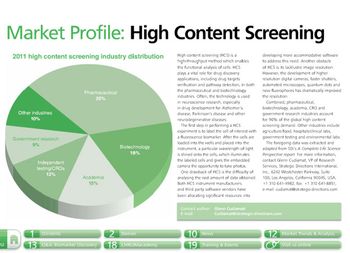
MktProPie0320_web.jpg

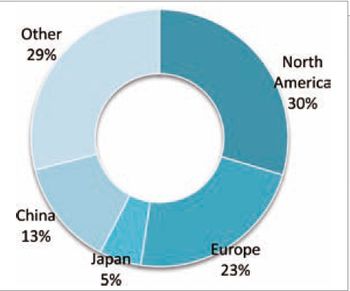
Flash chromatography is a purification technique that is designed for rapid separation by using air pressure as opposed to slow and inefficient gravityfed chromatography. It differs from the conventional column technique by using slightly smaller silica gel particles and pressurized gas at 50–200 psi.
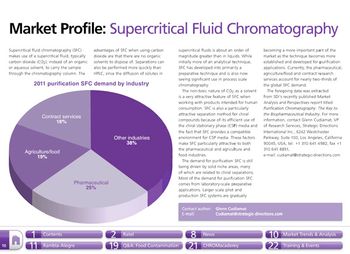
LCGCMay2109MktProPie-web.png

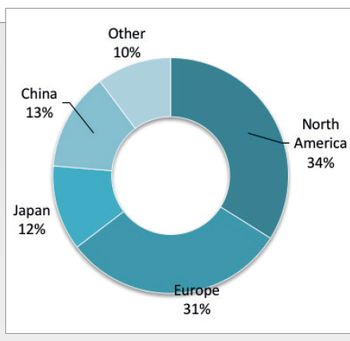
Gas chromatography (GC) sampling of volatile organic compounds (VOCs) is typically done by headspace, purge and trap, or thermal desorption instruments. Headspace sampling is the simplest of the techniques, where a vapor sample is taken from the space above the liquid sample in a GC vial.

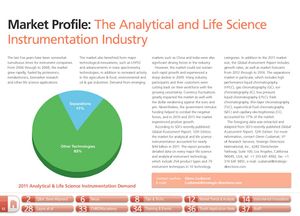
LCGC1118MktPro.jpg

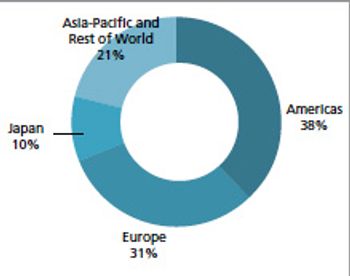
For high performance liquid chromatography (HPLC), ultrahigh-pressure LC (UHPLC), and LC–mass spectrometry (LC–MS) technologies, China has continued to provide solid growth opportunities, as a result of the country’s investments in the pharmaceutical industry, as well as agriculture and food testing.

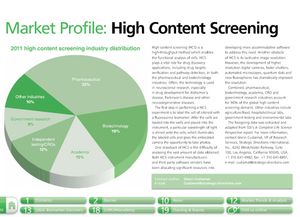
LCGC0518MktPro.png

Cannabis products are frequently tested for potency, pesticides and fungicides, solvent residues, heavy metals, microbes, foreign organic matter, and moisture. The most common techniques used for these tests are high-performance liquid chromatography (HPLC), gas chromatography (GC), LC or GC with mass spectrometry detection, and inductively coupled plasma–MS.

LCGCJan2018MktPro.jpg

Ion chromatography (IC) is a form of liquid chromatography that is able to measure the concentrations (in parts per billion) of anions such as chloride, fluoride, nitrate, and sulfate, and cations such as ammonium, calcium, magnesium, and sodium.

MT&A-791421-1408595935574.jpg

A market profile of Chromatography Data Systems (CDS's) using data extracted and adapted from SDi's recently published Market Analysis and Perspective (MAP) report titled High Performance Liquid Chromatography: Competing Techniques Setting the Bar Higher.

MT&A-784435-1408601899079.jpg

In continuous flow analysis (CFA), a sample is injected into a flowing carrier solution passing rapidly through small-bore tubing. The sample is mixed with a reagent, which reacts with the sample to develop a color and determine the sample concentration. The use of carefully controlled flow conditions ensures that the color development reaction is reproducible, so that the color measurement need not wait until the reaction has gone to completion.

MT&A-764223-1408606569278.jpg

Although the Indian economy has garnered world attention with its importance in the IT and service sectors, the country has recently become far more prominent in industries that are strong sources of demand for analytical instrumentation. Foremost among these are the country?s life science industries including pharmaceuticals, biotechnology, contract research organizations and the public sector comprised of academia and government.

Mt&A-757847-1408611649193.jpg

Life science research has been a driving force behind the $40 billion analytical instrument market growth over the last decade, resulting in new products, applications, markets and companies. These opportunities have revitalized revenues for many industry participants and fundamentally changed the analytical instrument business, technological advancements and a shifting of focus and reorganization of top companies.

MT&A-750385-1408612764815.jpg

Automating the DNA sequence process is made possible by the use of fluorescent tags. With fluorescent dyes, the entire experiment can be performed in a single solution instead of four different ones. Using Sanger-based methods, the DNA fragments migrate through the gel and the colour associated with each successive peak is detected using a laser. The DNA sequence is read by determining the sequence of colours in the peaks as they pass the detector and then fed directly to a computer for instant results.

Latest Updated Articles