The basic types of column overload (volume and mass) and the variables that most affect the sample loading capacity in PLOT column chromatography are examined.
The basic types of column overload (volume and mass) and the variables that most affect the sample loading capacity in PLOT column chromatography are examined.

Knowing the variables that most affect the sample loading capacity in a porous layer open tubular (PLOT) column is vital to determining how much sample to inject.

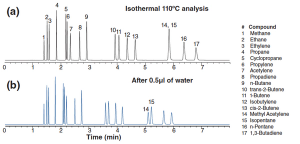
The effects of water on retention and selectivity in gas–solid chromatography of various adsorbent PLOT columns is reviewed.

Solid adsorbent gas chromatography (GC) columns, such as porous layer open tubular (PLOT) columns, are the best option for GC analysis of C1–C5 hydrocarbons, but water can affect retention and selectivity. We review the effects of water for different types of PLOT columns, and explain how to prevent or remediate the problem.

Low-pressure gas chromatography (LPGC)–MS should be the first option in many GC–MS applications to provide fast, sensitive, and robust analyses; and the installation, instrumentation, and implementation of LPGC is possible in any GC–MS system.

The Column
Wouldn’t it be nice if we could make nitrogen work for applications where helium is not an option?

LCGC Europe
A practical guide on how to get the most from porous layer open tubular gas–solid chromatography columns.

LCGC North America
GC expert Jaap de Zeeuw explores the historical development of PLOT columns, covers details of the most popular stationary phases, and provides practical hints.

June 1st 2022