The authors developed a new analytical HPLC method using a silica hydride-based column to analyze mushrooms.
Department of Chemistry, San Jose State University.
The authors developed a new analytical HPLC method using a silica hydride-based column to analyze mushrooms.

LCGC Asia Pacific
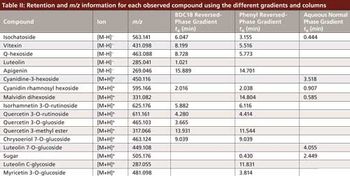
Using a liquid chromatography–mass spectrometry (LC–MS) method in conjunction with two complementary types of chromatographic retention modes-reversed phase and aqueous normal phase-various compounds present in mesquite flour extracts were identified. Because of the diverse types of chemical constituents found in such natural product extracts, a single chromatographic mode may not be sufficient for a comprehensive characterization. However, the combination of reversed-phase and aqueous normal phase LC can encompass a wide range of analyte polarity. This characterization of the composition of mesquite flour could be used in future studies to elucidate the beneficial health effects of its consumption.


LCGC Europe
Using a liquid chromatography–mass spectrometry (LC–MS) method in conjunction with two complementary types of chromatographic retention modes - reversed phase and aqueous normal phase - various compounds present in mesquite flour extracts were identified. Because of the diverse types of chemical constituents found in such natural product extracts, a single chromatographic mode may not be sufficient for a comprehensive characterization. However, the combination of reversed-phase and aqueous normal phase LC can encompass a wide range of analyte polarity. This characterization of the composition of mesquite flour could be used in future studies to elucidate the beneficial health effects of its consumption.
Special Issues
Using an LC–MS method in conjunction with two complementary types of chromatographic retention modes-reversed phase and aqueous normal phase-various compounds present in mesquite flour extracts were identified. Because of the diverse types of chemical constituents found in such natural product extracts, a single chromatographic mode may not be sufficient for a comprehensive characterization. However, the combination of reversed phase and aqueous normal phase LC can encompass a wide range of analyte polarity. This characterization of the composition of mesquite flour could be used in future studies elucidating the beneficial health effects of their consumption.

LCGC Europe
Adequate detection of trans-resveratrol in wine is complicated by two factors: relatively low levels and interferences from matrix components. Here, we present two useful approaches to overcoming these issues depending on the instrumentation available. For high performance liquid chromatography (HPLC) analyses with ultraviolet (UV) detection, matrix peaks can be removed by microextraction using a packed sorbent while simultaneously concentrating the trans-resveratrol peak by a factor of two. For liquid chromatography–mass spectrometry (LC–MS), the extracted ion chromatogram for the [M + H]+ analyte ion can be used to obtain specificity without prior extraction procedures.

LCGC North America
Adequate detection of trans-resveratrol in wine is complicated by two factors: relatively low levels and interferences from matrix components. Here, we present two useful approaches to overcoming these issues depending on the instrumentation available. For HPLC–UV analyses, matrix peaks can be removed by microextraction using packed sorbent while simultaneously concentrating the trans-resveratrol peak by a factor of two. For LC–MS, the extracted ion chromatogram for the [M + H]+ analyte ion can be used to obtain specificity without prior extraction procedures.

LCGC Asia Pacific
Limonin was separated from other components in citrus juice sample matrices by reversed-phase chromatography with ultraviolet detection.
LCGC North America
Limonin was separated from other components in citrus juice sample matrices by reversed-phase chromatography with ultraviolet detection.

LCGC North America
A guide to using HPLC in an iterative form to clarify decision-making during method development

LCGC North America
The terms hydrophilic interaction liquid chromatography (HILIC) and aqueous normal phase (ANP) chromatography very often are used interchangeably.

LCGC North America
Separation and retention of both polar and nonpolar compounds by the same stationary phase can be a useful approach for analyses of complex samples with a broad range of chemical properties. Typical stationary phases are designed for retention of either polar or nonpolar compounds so that multiple steps are required when designing a separation strategy. Hydride silica–based stationary phases are new materials with properties that allow for the simultaneous retention of both polar and nonpolar compounds over a range of aqueous–organic mobile phase compositions. Adjustment of the aqueous–organic ratio will determine whether polar or nonpolar compounds have greater retention.