Slalom Chromatography (Part 1): From Gels to Modern UHPLC Slalom Chromatography
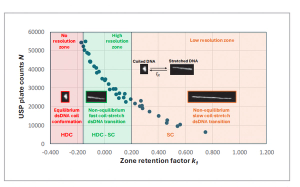
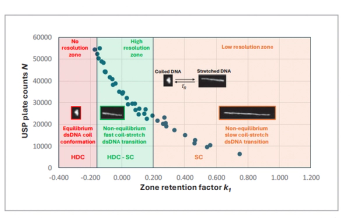
Part 1 of this two-part article series reviews the history of slalom chromatography (SC), the rationale for its recent revival, and the updated mechanistic framework of this technique. Rooted in the fundamental physical properties of deoxyribonucleic acid/ribonucleic acid (DNA/RNA) biopolymers and laminar flow dynamics in packed chromatographic beds, SC is highlighted for its most promising applications in cell and gene therapy. Recent two-year experimental investigations have revealed that SC operates through an out‑of‑equilibrium mechanism, coupling the entropic elasticity of double‑stranded deoxyribonucleic acid/ribonucleic acid (dsDNA/RNA) with the extension and shear forces generated within the interparticle spaces of ultrahigh-pressure liquid chromatography (UHPLC) columns. In contrast to gel permeation chromatography (GPC) or hydrodynamic chromatography (HDC), SC functions at high speed and uniquely elutes smaller dsDNA fragments first, followed by progressively larger ones. Unlike agarose gel electrophoresis (AGE), SC achieves separations of large DNAs in less than three minutes, with nearly twice the resolution power of typical AGE. These findings paved the way for the recent design of a new SC column intended for use in cell and gene therapy as an alternative to standard AGE. Further applications of this new SC column within cell and gene therapy workflows will be discussed in Part 2.