Ricard Boqué

Articles by Ricard Boqué

i8_t-581574-1417781182485.jpg

The concept of the limit of detection (LOD) has been, and still is, one of the most controversial in analytical chemistry. The multiple definitions and calculation methods proposed have contributed to this situation. Although in the last years, several international organizations, such as ISO or IUPAC, have tried to reach a consensus in their definitions and have issued guidelines for the estimation of this important parameter in chemical analysis, the subject is still a matter of scientific debate. In this article, we try to clarify the definition and provide guidelines to estimate LOD in chromatographic methods of analysis.
i4-572713-1408670308039.jpg

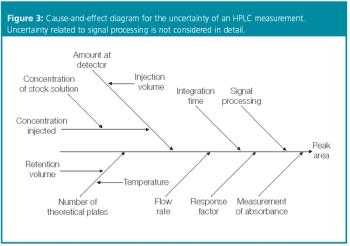
Estimating uncertainty has become one of the most important metrological concepts in analytical science over the last 15 years to such an extent that some authors consider a result useless or invalid unless it is accompanied with an uncertainty statement. This article describes how to estimate uncertainty in chromatographic analysis and how laboratories can calculate it using data from the method validation process.

i4-434923-1408659650178.jpg

Calibration refers to the process of determining the relation between the output (or response or signal) of a measuring instrument and the value of the input quantity or property. Depending on the univariate or multivariate character of the response (signal) used; either a univariate or a multivariate calibration is performed. The different calibration approaches are summarized in this article.

The authors discuss zero-, first- and second-order data and describe the advantages of using second-order chromatographic data compared with the more traditional univariate or multivariate calibration. They demonstrate how its use can uncover much more information from chromatograms and spectra.

Latest Updated Articles

