
This article explores the use of chromatographic retention measurements in both LC and SFC to develop quantitative retention activity relationship (QRAR) models, offering a predictive tool for skin permeability without animal testing.
This article explores the use of chromatographic retention measurements in both LC and SFC to develop quantitative retention activity relationship (QRAR) models, offering a predictive tool for skin permeability without animal testing.

Special Issues
This article provides an overview of the most recent advances in the field of chiral and achiral separations in SFC. This involves research focused on the most critical parameters in SFC separations, but also on practical issues such as the serial coupling of columns.

LCGC Europe
In multivariate calibration and modelling a model is built between a large data matrix containing many variables for each sample and the property of the sample.
LCGC Europe
The various steps of an experimental design-based approach are considered and the problems that arise from wrong choices are described.
LCGC Europe
A systematic approach to developing drug impurity profiling methods.
LCGC Europe
In this Practical Data Handling column, method development for drug impurity profiling is discussed.
LCGC Europe
Part two of the column on response surface designs looks at data analysis and various approaches to simultaneously optimize multiple responses

LCGC Europe
Experimental designs are used in method development and robustness testing and have been discussed in an earlier article.1 An experimental design is an experimental set-up that allows the simultaneous examination of a predefined number of factors in a predefined number of experiments. Method development is often divided into a screening and an optimization step. During the first step, many factors, potentially affecting the method, are screened to determine the most important factors, which are then further optimized.1

LCGC Europe
The concept of the limit of detection (LOD) has been, and still is, one of the most controversial in analytical chemistry. The multiple definitions and calculation methods proposed have contributed to this situation. Although in the last years, several international organizations, such as ISO or IUPAC, have tried to reach a consensus in their definitions and have issued guidelines for the estimation of this important parameter in chemical analysis, the subject is still a matter of scientific debate. In this article, we try to clarify the definition and provide guidelines to estimate LOD in chromatographic methods of analysis.
LCGC Europe
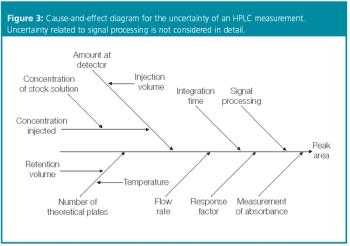
Estimating uncertainty has become one of the most important metrological concepts in analytical science over the last 15 years to such an extent that some authors consider a result useless or invalid unless it is accompanied with an uncertainty statement. This article describes how to estimate uncertainty in chromatographic analysis and how laboratories can calculate it using data from the method validation process.

LCGC Europe
Herbs and their extracts are currently being used for preventive and therapeutic goals. Consequently, the identification and quality control of these natural products is becoming increasingly important. Fingerprint chromatography is accepted as an appropriate identification and quality evaluation technique for medicinal herbs. This article reviews the development procedure of a fingerprint and different ways to handle the fingerprint data.
LCGC Europe
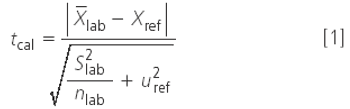
The assessment of accuracy, which involves the estimation of precision and the determination of trueness, refers to the process of evaluating whether the results provided by analytical methods are close to accepted reference values. The different references available in chromatographic analysis and useful guidelines to perform such a comparison are described.

LCGC Europe
Screening designs are used to screen for important factors during method optimization or in robustness testing. Usually, two-level screening designs, such as fractional factorial and Plackett–Burman designs, are applied. This column discusses the properties of these designs.

LCGC Europe
Calibration refers to the process of determining the relation between the output (or response or signal) of a measuring instrument and the value of the input quantity or property. Depending on the univariate or multivariate character of the response (signal) used; either a univariate or a multivariate calibration is performed. The different calibration approaches are summarized in this article.
LCGC Europe
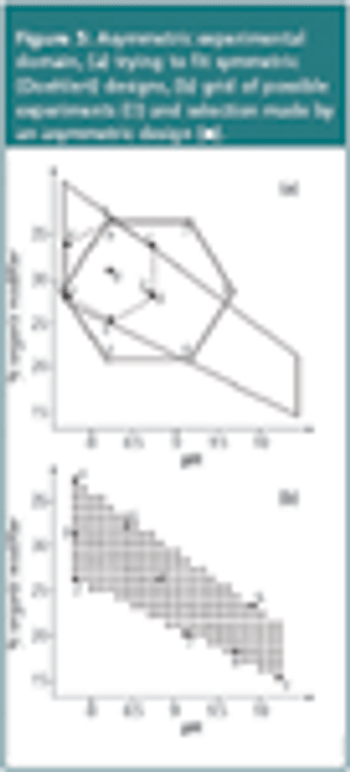
An experimental design can be considered as a series of experiments that, in general, are defined a priori and allow the influence of a predefined number of factors in a predefined number of experiments to be evaluated.

LCGC Europe
The robustness/ruggedness of an analytical procedure is a measure of its capacity to remain unaffected by small but deliberate variations in method parameters.

LCGC Europe
This article presents an overview of the work performed to define generic separation strategies and methods in chiral method development using capillary electrochromatography as a separation technique. Polysaccharide chiral stationary phases were found suitable for this purpose. Two separate strategies were defined, one for acidic and one for non-acidic substances. These strategies were evaluated and found applicable on structurally diverse molecules, showing their generic character.

LCGC Europe
Analytical chemists are concerned with the quality of their methods and results. An important question in this context is whether the precision of a newly developed and validated method is up to standard. In other words: is the precision of the newly developed method comparable to what could be expected? This article looks at how the Horwitz equation can answer this. It also describes the results of an extensive study involving 10000 laboratories which indicates that the relative reproducibility approximately doubles for every 100-fold decrease in concentration and that, surprisingly, it does not depend on the type of material or method.
LCGC Europe
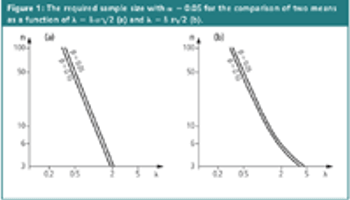
The sample size is determined by three factors: the size of the difference between the means that should be detected, the precision of the methods being compared and the significance levels at which the test is performed.

November 1st 2010
April 1st 2010