This article reviews SIFT-MS odor analysis in food-flavor, packaging, and environmental applications, suggesting potential utilization as an objective screening tool.

Vaughan Langford is a principal scientist at Syft Technologies in New Zealand. He joined Syft in late 2002 after completing his Ph.D. in physical chemistry at the University of Canterbury, and postdoctoral fellowships at the Universities of Geneva, Western Australia, and Canterbury. He has over 30 peer-reviewed publications on a wide range of SIFT-MS applications, and has contributed numerous conference papers. Direct correspondence: vaughan.langford@syft.com

This article reviews SIFT-MS odor analysis in food-flavor, packaging, and environmental applications, suggesting potential utilization as an objective screening tool.

Atmospheric volatile organic compounds (VOCs) impact human health, quality of life, and the environment. Since industry contributes significant VOC pollution, fenceline monitoring is essential to ensuring compliance with applicable regulations. Conventional use of passive or grab samples analyzed at the laboratory fails to capture dynamic changes, and particularly fails to detect pollution incidents rapidly. In contrast, SIFT-MS instruments mounted in mobile laboratories provide on-site, real‑time analysis that enables rapid identification of “hot” zones via both on-the-move analysis and monitoring at fixed locations. Combined with drone sampling, the specific pollution source can be located.

A high-level assessment of the sustainability of the SIFT-MS technique and its automated variant is conducted using White Analytical Chemistry (WAC) principles.

The method of standard additions (MoSA) enables quantification of volatile impurities in condensed-phase samples, such as emulsions, for which matrix-matched calibration standards are required. The technique is, however, expensive because it requires multiple analyses of each sample.

Pharmaceutical excipients, such as polyethylene glycol-based polymers, must be tested for the presence of ethylene oxide (EtO) and 1,4-dioxane as part of a safety assessment, according to USP Chapter <228>.

Selected ion flow tube mas spectrometry (SIFT–MS) offers real-time measurements directly from air without chromatography or sample preparation, providing an attractive alternative for these hard-to-measure volatile organic compounds.

This article surveys the application of headspace-SIFT-MS to untargeted screening of food products and ingredients, such as beer, olive oil, Parmesan cheese, and strawberry flavor mixes.

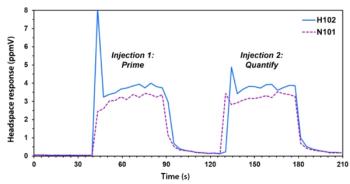
Multiple headspace extraction (MHE) can be readily implemented with automated headspace-selected ion flow tube mass spectrometry (SIFT-MS).

Applying headspace-SIFT-MS to untargeted screening of food products and ingredients.

Direct-injection mass spectrometry (DIMS) and gas chromatography (GC) approaches have some significant differences that are pertinent when analyzing volatile organic compounds (VOCs). We explain.

SIFT–MS analysis has potential to screen large numbers of packaging samples for the volatile MOH fraction, providing a rapid indication of packaging material contamination.

The differences between DIMS and GC approaches are presented.

Newer direct-injection mass spectrometry techniques can improve real-time monitoring of volatile organic compounds.

Ensuring that volatile leachable impurities are at low levels in polymeric materials is very important for minimizing migration to food and pharmaceutical products.

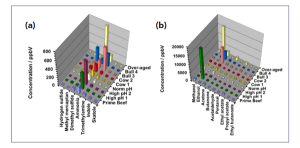
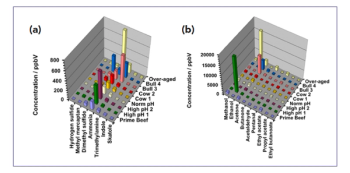
Application of multivariate statistical analysis to a combined data set demonstrated that SIFT-MS discriminates premium quality beef from eight sensory defects, and, therefore, could be applied as an instrumental grading tool, obviating sensory panel grading.

For the BTEX compounds, detection limits in the single-digit parts-per-billion concentration range (by volume) are readily achievable within seconds using selected ion flow tube mass spectrometry (SIFT-MS), because sample analysis is achieved without chromatography, preconcentration, or drying.

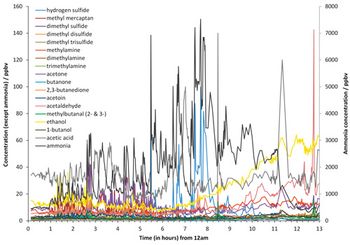
The sensitive, selective, and real-time analysis characteristic of the SIFT-MS technique provides simple, robust, and continuous analysis of extremely diverse odor compounds at trace levels in air. This application note illustrates instantaneous, broad spectrum odor analysis with monitoring data from a chicken meat production facility.

Published: May 3rd 2024 | Updated:

Published: April 1st 2022 | Updated:

Published: September 7th 2022 | Updated:

Published: September 8th 2023 | Updated:

Published: August 8th 2024 | Updated:

Published: May 1st 2023 | Updated: