Articles by William Goodman
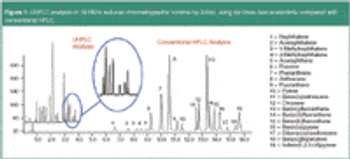
Polynuclear aromatic hydrocarbons (PAHs) are carcinogenic condensed ring aromatic compounds widely found as trace pollutants in waters, wastes, air particulates, soil and foods. PAHs can be routinely monitored using HPLC with a combination of UV and fluorescence detection as prescribed in EPA methods 550.1, 610 and 8310.

Melamine is an industrial chemical with a high nitrogen content that can cause kidney stones and lead to renal failure. In some instances, melamine has been added to baby formula and dairy products as a substitute for protein. This paper presents an efficient and definitive gas chromatography–mass spectrometry (GC–MS) method to identify melamine and related compounds based on the released US Food and Drug Administration (FDA) method.

Melamine is an industrial chemical with a high nitrogen content that can cause kidney stones and lead to renal failure. In some instances, melamine has been added to baby formula and dairy products as a substitute for protein. This paper presents an efficient and definitive gas chromatography–mass spectrometry (GC–MS) method to identify melamine and related compounds based on the released US Food and Drug Administration (FDA) method.

The United States Pharmacopeia (USP) has implemented a revised method for the determination of residual solvents, chapter 467; this revision has brought the methodology of USP 467 into close alignment with European Pharmacopeia (EP) method 2.4.24. The USP and EP determination of class 1 and class 2 residual solvents is performed with static headspace (HS) sample introduction and gas chromatography (GC) with flame ionization detection (FID); class 3 has flexibility in the technique, however, it is often included in the HS analysis.

Phthalates are added to plastics to increase flexibility. Recently, concerns have been raised over the effect of phthalate exposure from plastic materials on human health.
By William Goodman, PerkinElmer, Inc.

The process of investigating a suspicious fire includes many different types of analyses. An essential step in confirming the presence of a liquid accelerant is gas chromatography (GC); detection with a mass spectrometer (MS) provides an accurate confirmation of both the presence and identity of an accelerant. In arson analysis, the sample preparation for GC–MS analysis is typically performed by headspace or solvent extraction.

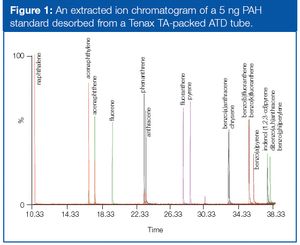
Polycyclic aromatic hydrocarbons (PAHs) are commonly found throughout the environment in soil, water and adsorbed to fine particulate matter in air. Of the 16 common PAHs, 7 have been classified as animal carcinogens by the International Agency for Research on Cancer (IARC). Resulting from this classification, PAHs are monitored and regulated in the environment.
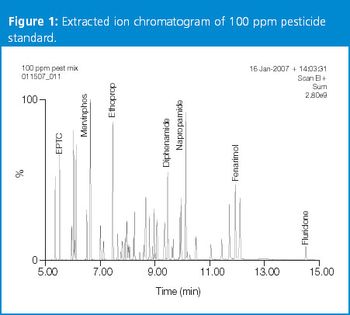
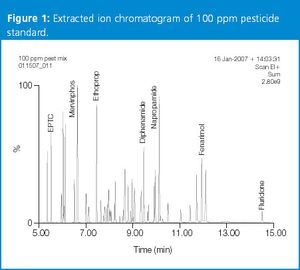
Pesticide contamination of foodstuffs has become a worldwide concern, prompting various levels of regulation and monitoring. Traditionally, pesticides are quantified with gas chromatography (GC) combined with selective detectors (ECD, FID, etc.). Selective GC detectors are great tools to quantify one or two classes at a time. However, screening for a number of different classes of pesticides requires multiple runs utilizing various GC configurations to achieve sufficient chromatographic resolution for unambiguous quantification. Gas chromatography–mass spectrometry (GC–MS) provides positive confirmation of various pesticides in a single analytical run because its superior selectivity allows interference-free quantification even with peak coelution. GC–MS has become a preferred technique for pesticide analysis because of its single-run capability.

William Goodman and Thomas Meaker, PerkinElmer Life and Analytical Sciences

This application note will demonstrate a GC–MS analysis of common polybrominated diphenyl ether (PBDE) congeners. An optimized method will allow the Clarus GC–MS to provide ample separation and high yields of all PBDE congeners. The extended mass range of the Clarus 500 MS and high-mass calibration will produce mass spectra with very high levels of accuracy.