

The Column
Click the title above to open The Column April 2019 Europe & Asia issue, Volume 15, Number 4, in an interactive PDF format.
The Column
Click the title above to open The Column April 2019 Europe & Asia issue, Volume 15, Number 4, in an interactive PDF format.
The Column
Click the title above to open The Column April 2019 North American issue, Volume 15, Number 4, in an interactive PDF format.

The Column
The detection of drugs or other toxic substances can be crucial to forensic investigations. However, if the investigation involves a heavily decomposed, skeletonized, or missing corpse, that information can be difficult to obtain, and may require the skills of a unique branch of forensic toxicology-entomotoxicology. To explain the role of chromatography in this field, The Column spoke to Paola A. Magni from Murdoch University, in Perth, Australia.

The Column
Highly repeatable fragmentation of the compounds into the ion source is one of the major advantages of using gas chromatography coupled with electron ionization mass spectrometry (GC–EI-MS) for the analysis of volatile and semivolatile compounds. The generation of intense and diagnostic fragmentation when the ionization is performed at 70 eV has been used for the creation of many established databases-enabling the analyte identification process.

The Column
The House of Lords EU Home Affairs Sub‑Committee has highlighted the risk of losing access to key sources of Horizon 2020 funding in a “no-deal” scenario and called on the Government to confirm that the UK will seek full association to the next phase of the programme, “Horizon Europe”.
The Column
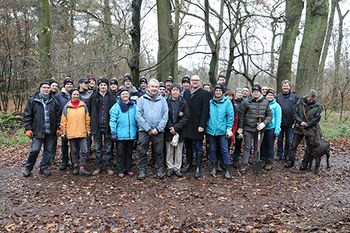
Shimadzu employees have volunteered to reforest an area in the Duisburg city forest (Germany) planting 1500 new trees and contributing to the long-lasting woodlands development.
The Column
Restek Corporation and LECO have agreed an expanded collaboration that will allow LECO customers access to a core set of Restek consumables.

The Column
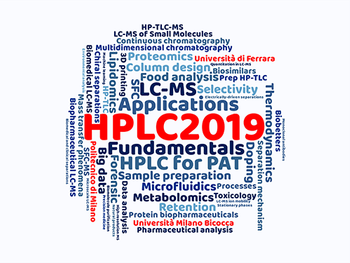
The 48th International Symposium on High Performance Liquid Phase Separations and Related Techniques (HPLC 2019) will be held 16–20 June 2019 at the Milano-Bicocca University, in Milan, Italy. This is the first time that this symposium will be held in Italy.
The Column
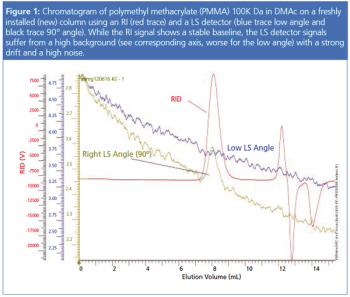
The addition of a light scattering detector dramatically increases the capabilities of gel permeation chromatography/size-exclusion chromatography (GPC/SEC) analysis. However, the complexity of the system also increases. This instalment of Tips & Tricks discusses column issues when working with light scattering detectors.

The Column
This is the first in a series of articles exploring current topics in separation science that will be addressed at the HPLC 2019 conference in Milan, Italy, from 16–20 June.

The Column
The “5th Workshop on Analytical Metabolomics” will be held in Thessaloniki, Greece, from the 13–17 May 2019. Here is a sneak preview of what attendees can look forward to.

The Column
A fully automated method for the effective drug screening of large populations based on dried blood spot (DBS) technology is presented. DBSs were prepared, scanned, then spiked with deuterated standards, and directly extracted, before they were transferred online to an analytical liquid chromatography (LC) column and then to the electrospray ionization tandem mass spectrometry (ESI-MS/MS) system. The method was applied to DBS samples from two patients with back pain; codeine and oxycodone could be identified and quantified accurately below the level of misuse of 89.6 ng/mL and 39.6 ng/mL, respectively.