The Column-08-22-2017

Rogers.jpg

The Column

Fresh fruit and vegetables have a limited shelf life and so there is a need to ensure that the products reach the shelf in a timely manner and with as little spoilage as possible. Volatile organic compounds (VOCs) are an easily accessible way of monitoring changes in fresh produce. Hilary J. Rogers and Carsten T. Müller from the School of Biosciences at Cardiff University, Cardiff, Wales, UK, investigate these VOCs in fruit and vegetables using gas chromatography–mass spectrometry (GC–MS). They recently spoke to The Column about this research.

Olive oil.jpg

The Column

A method to determine the quality of olive oil has been developed using a novel atmospheric pressure chemical ionization (APCI) source in combination with gas chromatography (GC) coupled to hybrid quadrupole time-of-flight mass spectrometry (QTOF-MS) and a metabolomics strategy.

Cocao.jpg

The Column

Researchers from the Université de Strasbourg, France, have developed a method to discover cocoa bean origin by analyzing chocolate polyphenols using high performance liquid chromatography–diode array detection–mass spectrometry.

figure 1 L.png

The Column

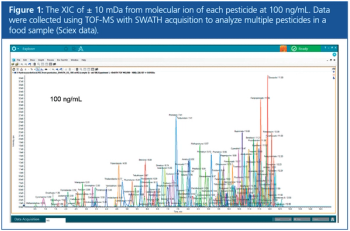
Food testing laboratories worldwide are responsible for checking the presence of regulated pesticide residues on food products because these chemicals can be harmful to health and the environment. These laboratories have traditionally relied on gas chromatography coupled with mass spectrometry (GC–MS) for rapid and reliable pesticide detection in large sample numbers. However, changing regulations and increasingly diverse pesticides are driving the need for alternative liquid chromatography tandem mass spectrometry (LC–MS/MS)- based methods for comprehensive screening.

figure 1 L1503414383468.png

The Column

This article describes the application of liquid chromatography tandem mass spectrometry (LC–MS/MS) and enhanced multiple reaction monitoring (MRM) spectrum libraries for multi-pesticide residue analysis. Using these methods, a high number of fragment ion transitions of target compounds can be examined to increase specificity and reporting confidence, reducing the risk of false positive or false negative detection.

cookies.jpg

The Column

This proof-of-principle study shows that dynamic headspace sampling with thermal desorption–gas chromatography–time‑of-flight mass spectrometry (TD–GC–TOF-MS) analysis can be used to investigate the complex aroma profiles released from flavoured cookies. Key flavour compounds in chocolate-chip, peanut, and orange-cream cookies are highlighted, and the effect of raising the headspace extraction temperature is examined.

figure 1 L1503418634328.png

The Column

A rapid and sensitive ultrahigh-pressure liquid chromatography tandem mass spectrometry (UHPLC–MS/MS) method was developed to simultaneously determine six plant growth regulators in bean sprouts with a simple preparation. Analyte extraction from samples was effectively performed using liquid–liquid extraction (LLE) by acetonitrile. Chromatographic separation was conducted on a C18 reversed-phase column with gradient elution. The analytes were detected by tandem quadrupole MS after negative electrospray ionization by multiple reaction monitoring. The developed method was validated by testing method specificity, matrix effect, sensitivity, linearity, accuracy, and precision.

RAFA.jpg

The Column

A preview of RAFA 2017, which will be held 7–10 November 2017 in Prague, Czech Republic.