LCGC Europe-06-01-2015

LCGC1_i1-New-1433343319484.jpg

LCGC Europe

The numerous advantages of translating gradient chromatographic methods between the differing formats of LC have been explored and discussed. While translations in principle obey well defined chromatographic theories, the authors investigate a number of potential pitfalls that may result in poor translations as exhibited by selectivity differences, changes in efficiency, and hence failure to meet resolution system suitability criteria.

LCE0615_Column-Watch_Figure-4.jpg

LCGC Europe

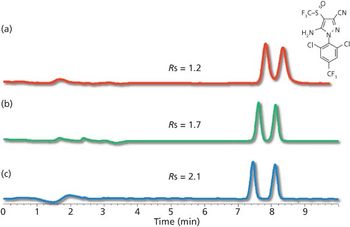
The use of superficially porous particles (SPPs) in the manufacture of high performance liquid chromatography (HPLC) columns has become prominent in recent years. Over the course of the past decade most major manufacturers have built column lines around the technology. At the recent Pittcon conference in New Orleans, Louisiana, USA, a large number of oral and poster presentations centred on the current research and advances using superficially porous particles. This instalment aims to provide some highlights of these recent trends.

LCE0615_HPLC-Figure-4.jpg

LCGC Europe

This instalment provides an overview of modern practices of high-throughput purification to support small-molecule drug discovery. It describes the use of reversed-phase liquid chromatography (LC) and supercritical fluid chromatography (SFC) for purifying diverse samples in a centralized laboratory setting. A case study is used to illustrate the principles and rationales for selecting operating parameters for these applications. This is the first instalment of four articles on “Separation Science in Drug Development” to describe the modern practice of separation science in supporting small-molecule drug discovery and development.
