

E-Separation Solutions
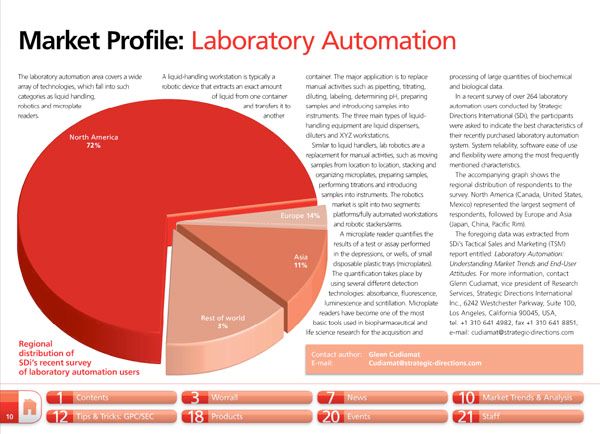
The laboratory automation area covers a wide array of technologies, which fall into such categories as liquid handling, robotics, and microplate readers.
E-Separation Solutions
The laboratory automation area covers a wide array of technologies, which fall into such categories as liquid handling, robotics, and microplate readers.

The Column
The rapid expansion in China continues to fuel growth for separation science technologies. This market includes technologies such as HPLC, gas chromatography (GC), ion chromatography, low-pressure liquid chromatography, flash chromatography, thin-layer chromatography, chemical sensing, capillary electrophoresis and discrete and continuous flow analysers.

E-Separation Solutions
The rapid expansion in China continues to fuel growth for separation science technologies. This market includes technologies such as HPLC, gas chromatography (GC), ion chromatography, low-pressure liquid chromatography, flash chromatography, thin-layer chromatography, chemical sensing, capillary electrophoresis, and discrete and continuous flow analyzers.

E-Separation Solutions
Supercritical fluid chromatography (SFC) makes use of a supercritical fluid, typically carbon dioxide (CO2), instead of an organic or aqueous solvent, to carry the sample through the chromatography column.

E-Separation Solutions
The techniques involved in successfully separating and quantifying the amino acids vary from instrument to instrument. However, the processes for amino acid analysis are similar, involving hydrolysis, labeling, separation, and detection followed by data analysis.
E-Separation Solutions
Flow cytometry is an analytical technique utilized to examine the physical and chemical properties of cells and microparticles, including beads.

E-Separation Solutions
Solid-phase extraction (SPE) has been commercially available for over twenty years and is still finding new applications.

E-Separation Solutions
Thin layer chromatography (TLC) is a planar chromatographic technique introduced in the 1950s as a fast, easy, and inexpensive method for qualitative analysis.

E-Separation Solutions
Compressed gases, such as nitrogen and hydrogen, have become an integral part of any laboratory.

E-Separation Solutions
Gas chromatography-mass spectrometry (GC-MS) is the most widespread tandem technique in the analytical instrumentation industry. In fact, these systems account for the largest installed base of mass spectrometry instruments.

E-Separation Solutions
Ion chromatography (IC) is a similar technique to HPLC except that the detector of choice is usually a conductivity detector.

E-Separation Solutions
The environmental market had seen its share of milestones with roots dating back to the 1950s with the Air Pollution Act, followed by the Clean Air Act of 1963. Throughout the next half-century, the Clean Air Act has seen various revisions and additions.

Liquid Chromatography users are asked about their experience with UHPLC

E-Separation Solutions
The market for high performance liquid chromatography continues to be one of the most dynamic markets of the analytical instruments industry.

E-Separation Solutions
The global food, beverage, and agriculture industry caters to the population of the entire world. Even though the food industry does not rely on laboratory instrumentation to the same extent as perhaps other industries, the sheer size of the industry results in a considerable market for laboratory instruments. Many applications are related to safety, quality control, and research of new food ingredients and products.

E-Separation Solutions
Edman degradation is a process of protein sequencing first discovered by a Swedish biochemist Pehr Victor Edman in 1950.

E-Separation Solutions
Like liquid and gas chromatography, molecular spectroscopy instruments are common tools in analytical and life science laboratories. Molecular spectroscopy technologies such as UV-Vis and IR are often incorporated as detectors for LC and GC instruments. Users will also use standalone (or off-line) molecular spectroscopy units as a complementary tool in many quality control and R&D laboratory settings.

E-Separation Solutions
With accountability and regulatory compliance being such a large part of the modern laboratory, the necessity for a laboratory information management system (LIMS) cannot be understated.
E-Separation Solutions
Flash chromatography is a type of preparative liquid chromatography commonly used in the separation of organic compounds.
E-Separation Solutions
Dissolution testing is a mandatory test for the physical evaluation of solid dosage forms, such as capsules, tablets, ointments, and creams. The most basic form of testing measures the rate of dissolution or solubility of a drug tablet. Dissolution testing can also be used in ADME and bioavailability studies, release rates of a drug substance under different conditions, as well as provide information as to the efficacy of in-vivo performance.
E-Separation Solutions
Capillary electrophoresis (CE), introduced in the 1980s, utilizes the same principles as gel electrophoresis for the qualitative and quantitative analysis of charged biological molecules, including proteins, carbohydrates, and nucleic acids as well as inorganic compounds.

E-Separation Solutions
The global market for analytical instrumentation increased from $26 billion in 2002 to more than $36 billion in 2007. The last few years have been particularly eventful for instrument companies with major acquisitions, partnerships, and other business developments. In addition, many industry participants reported record sales driven robust growth in China and other Asia Pacific areas.

LCGC North America
Water is one of the most abundant compounds found in nature. An estimated 1.4 billion cubic kilometers of water exists on Earth and it covers 70% of our planets surface. Water is also a key element to life and makes up 70% of the fat-free mass of the human body. It is not surprising then that water is used, to at least some extent, in nearly all industries, and to quite a significant extent in most. The need to analyze water for contaminants, as well as its life-supporting characteristics, is nearly as wide.
E-Separation Solutions
Water is one of the most abundant compounds found in nature. An estimated 1.4 billion cubic kilometers of water exists on Earth and it covers 70% of our planet’s surface. Water is also a key element to life and makes up 70% of the fat free mass of the human body.

LCGC North America
Despite a recent history of major innovation in many areas of the market, the position of mass spectrometry as one of the most powerful analytical techniques available, and the cutting edge applications in which it is used seem to drive the continuation of such a rapid pace of innovation and breakthroughs.