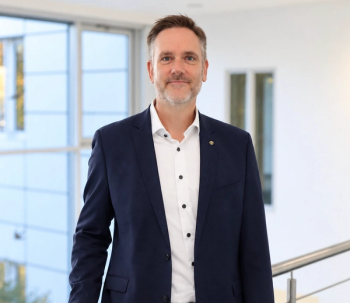
Florian Geistmann succeeded retiring Jürgen Semmler as Shimadzu Europa managing director on October 1.
Chris Pohl, a recognized and respected contributor to the evolution of ion chromatography and recipient of LGCC International’s Lifetime Achievement Award, discusses the past, present, and future of ion chromatography (IC).
Looking back over 50 years, what do you consider the most transformative milestone in the development of ion chromatography—and why?
It is challenging to limit the answer to this question to a single most transformative milestone because there are several that significantly impacted the development of ion chromatography (IC). If I were forced to choose a single milestone, it would have to be the development of high-capacity continuous suppression technology. In the beginning phase of ion chromatography using a packed bed suppressor, one had to be careful about the concentration of eluent used because the life of the suppressor was inversely proportional to the concentration of the eluent. That meant that for practical reasons, the eluent should not be more than 5–10 mM with respect to the suppressible ion. Fiber suppressors offered continuous operation, but they had similar concentration constraints, so it was not until high-capacity continuous suppression technology was developed that a much broader range of eluent concentrations could be utilized. Modern suppressors can readily suppress 100-mM eluent concentrations and, under some conditions, can process more than double this concentration. The much broader range of concentrations made it feasible to elute highly charged ions and polymeric species that were previously impossible to analyze using IC.
How has IC evolved to meet the demands of increasingly complex sample types compared to other liquid chromatography (LC) techniques?
One of the unique things about ion chromatography is that the choice of mobile phase is the constraining element. Unlike LC techniques, where a broad range of mobile phases is chosen using a few different retention modes, in the case of IC, the stationary phase must be designed to operate effectively with a suppressible mobile phase at a useful concentration. This means that the focus of the development of ion chromatography has always been on the column chemistry because that is the aspect that must be adjusted to make it compatible with the mobile phase of choice. In the early days of ion chromatography, there were several mobile phases that were commonly used, but for the most part, this has evolved into using hydronium-based eluents for cation separations and either hydroxide- or carbonate-based eluents for anion separations. Dealing with increasingly complex sample types tends to be mostly focused on either developing unique selectivity that provides the necessary separation for critical sample elements or increasing the column capacity so that trace components can be readily separated despite enormous concentration disparities between matrix substituents and target analytes. Other areas of LC tend to focus more on increasing efficiency for multidimensional chromatography as a means of dealing with more complex samples.
What were the key technological innovations that elevated IC from a niche technique to a mainstream analytical tool?
When it comes to key technological innovations, there are several that combined to make ion chromatography a mainstream analytical tool. The development of high-capacity suppressors, as I've already mentioned, is certainly one of these innovations. In addition to broadening the range of analytes that can be assessed using IC, the development of such suppressors enabled the first practical use of ion chromatography in gradient mode. Because retention of ions is strongly dependent upon the charge of the ion, the ability to use gradient elution allows the practical quantitation of ions with substantially different charges in a single analysis. The interest in gradient elution also drove the development of hydroxide-selective stationary phases. For the most part, hydroxide remains the mainstream eluent species for anions ingredient mode because the suppression product of hydroxide is water, which has a very low background conductivity. While Professor Purnendu Dasgupta has developed methods for removing most of the carbonate background, thus enabling carbonate gradients, carbonate gradients are still not widely utilized due to the increased complexity of quantitatively removing the carbonic acid suppression product (1). Initial ion chromatography stationary phases were incompatible with hydroxide mobile phases, but over the years, we were able to develop progressively more hydroxide-selective phases, ultimately making hydroxide mobile phases widely utilized for ion chromatography.
In a similar vein, early stationary phases for cation separations could only separate monovalent cations from one another or divalent cations from one another. The most significant innovation in this area was the recognition that using weak acid cation exchange materials provided an opportunity to separate both mono and divalent cations in a single run. The pioneer in this area was Gerhard Schomburg, who developed the first practical carboxylic acid column based on a butadiene-maleic anhydride copolymer. This ultimately led to a variety of different weak acid cation exchange phases capable of eluting the entire alkali metal and alkaline earth series in a single analysis (2).
One of the main stumbling blocks for using hydroxide is the tendency of hydroxide to become contaminated by carbon dioxide from the air. This contamination caused baseline drift and increased column re-equilibration time, making the application of ion chromatography to gradient elution a niche technique. It wasn't until the development of the eluent generator and the continuously regenerated trap column that production of high-purity hydroxide was finally possible, enabling the routine application of hydroxide gradients to ion chromatography.
IC–MS has also proven to be an important tool for certain analytical challenges, especially when using accurate mass instruments. For most applications of ion chromatography, the analytes are known and there is no need for mass spectrometry (MS), but when dealing with complex systems and novel analytes, it is frequently the best option for identifying unknown unknowns.
In what areas has IC had the most lasting and unique impact compared to other LC modalities?
The area of biggest impact for ion chromatography has been in the environmental application area. It is used in nearly all water distribution systems to assess the quality of drinking water, not just in developed nations but also in most parts of the world. The main application in the pharmaceutical area is in the analysis of pharmaceutical counterions. Another major application area for ion chromatography is in the power generation industry, particularly nuclear power, where it is used to assess the quality of the steam generator water. Finally, another vital application area is in the characterization of high-purity water, which is important for the semiconductor industry (3–6).
As someone deeply experienced in IC, what common misconceptions do you hear from reversed-phase LC users, and how would you correct them?
Probably the single biggest misconception is that ion exchange separations are much more complicated than reversed-phase separations and should therefore be avoided. At first glance, this might seem to be true because in reversed-
phase retention, it is inversely proportional to the concentration of solvent added to the mobile phase. In ion exchange, the same general behavior is observed, but this behavior is also affected by the charge of the analyte ion and the charge of the eluent ion. But while the elution process is a bit more complex, it is also highly predictable and can be effectively utilized to alter selectivity predictably. For example, doubling the eluent concentration of a monovalent eluent species will cut in half the retention of a monovalent analyte and reduce the retention of the divalent analyte by a factor of four. Thus, changing the eluent concentration will alter the relative position of the monovalent and the divalent species. In contrast, in reversed-phase LC, the increase in the amount of acetonitrile in the mobile phase can only be predicted based on empirical measurements with a specific column and analyte so it tends to be more complex to develop methods in reverse phase, particularly when encountering selectivity issues, forcing the user to evaluate multiple columns in multiple mobile phases in the hope of finding one that allows for the separation.
Can you share a case where IC outperformed other LC techniques in a surprising or critical application?
Probably the best example of this is the analysis of perchlorate in drinking water. Perchlorate is a highly polarizable anion, so you can get a bit of retention via reversed phase, but generally you need an ion-pair reagent to get
suitable retention to move it away from matrix ions. It might look okay with standards, but it doesn't work very well for real-world samples. On the other hand, IC–MS provides a practical solution that works well down to parts-per-trillion concentrations (7).
How has the role of IC in regulatory and compliance testing been involved, and what gives it an edge in trace-level ionic analysis?
The most obvious example where regulatory methods have played a significant role is in the analysis of ionic contaminants in drinking water. Many of the Environmental ProtectionAgency (EPA) methods associated with specific analytes, such as bromate, chlorate, chlorite, and perchlorate, were developed through a collaboration between Dionex and the EPA. Initially, the EPA developed methods on its own, but in more recent years, it has tended to collaborate with instrument companies willing to develop methods that are field tested. Often, we have developed columns and other specialized consumables in the course of this work to produce methods that are customized for the application.
What do you see as the future for IC in an era increasingly dominated by mass spectrometry and multidimensional separations?
In general, mass spectrometry has proven to be a useful but minor component in the portfolio of tools used in the analysis of inorganic ions and small organic ions. It does generally provide better sensitivity, but it suffers from matrix suppression and requires the use of isotopic standards to compensate for such issues. Furthermore, MS has yet to match the quantitative accuracy and precision of conventional IC or LC and is considerably more expensive to operate, so in my opinion, it is unlikely to ever dominate the ion analysis market.
Multidimensional separations are particularly important in extremely complex samples such as biological or environmental samples (8). Generally, ion chromatography is compatible with multidimensional separations and has some advantages over conventional multidimensional separations in that if the first separation includes a suppressor, the sample can be refocused on a second, smaller internal diameter column, allowing for signal amplification in concert with the multidimensional separation. This is an area that has considerable potential but has yet to be widely investigated.
If you had to make a case for every LC laboratory to add IC to their toolbox, what would be your strongest argument today, especially in terms of return on investment (ROI) and versatility?
To me, an IC instrument is very much like a pH meter in that it is an essential component of any laboratory. It can be used for characterizing the de-ionized water system in your laboratory to make sure it is working properly, assessing the purity of buffers and reagents, and characterizing manufacturing processes. A good example is the analysis of counterions in pharmaceutical products. Since many drug substances are supplied as a salt, the counterion has no direct pharmaceutical relevance, but the purity of the drug substance and the purity of the counterion are both important for assessing the quality of the final product. For that reason, most pharmaceutical development laboratories have at least one IC in the laboratory that they use as a shared resource to better understand the quality of the drug substance prior to clinical testing. Finding issues early in the development process can save enormous amounts of money compared to discovering the problem after the product has been released for clinical testing.
What advice would you give a young chromatographer who is considering specialization in IC, and how does the field stay vibrant and innovative going forward?
The one thing that IC needs to do to stay vibrant and innovative is to continue to push the envelope in terms of stationary phase chemistries and particle sizes. IC has stagnated for some years, using 4–5 µm particle sizes when LC is using much smaller particles. Part of the problem is connected to the pressure rating of polymeric components commonly used in IC. Exploring options that can circumvent these issues should be a high priority. Likewise, the development of smaller particles using polymeric stationary phases brings with it challenges associated with the pressure rating of polymeric materials. However, some polymeric particles are incredibly pressure resilient, so there are still opportunities to further reduce particle size without worrying about crushing the particles during the packing process.
Follow the LCGC Interview series this week to celebrate 50 years of ion chromatography with individual interviews with Joachim Weiss, Chris Pohl, and Brett Paul giving their views on the past present, and future of ion chromatography.
References
Biography
Christopher Pohl is a chromatography consultant for CAP Chromatography Consulting and President of Cap Chromatography LLC. He retired from Thermo Fisher Scientific in August 2021 where he was Vice President, Chromatography Chemistry.Christopher joined Dionex, now part of Thermo Fisher Scientific, in 1979 where the focus of his work was new stationary phase design.He is an author or co-author of 114 US patents, in a number of areas including separation methods and stationary phase design.He is the author or co-author of 14 book chapters and more than 157 papers.He received his BS in Analytical Chemistry from the University of Washington in 1973. He received the International Ion Chromatography Symposium Award in 1990, the Uwe Neue Award and the Eastern Analytical Symposium Separation Science Award in 2018, the 2020 Thermo Fisher Scientific - George N. Hatsopoulos Technical Innovation Award, the 2023 ACS Chromatography Award and the LCGC 2025 Lifetime Achievement in Chromatography Award.