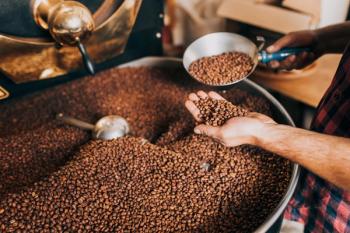
Liquid chromatography–tandem mass spectrometry (LC–MS/MS) finds low glyphosate residues of the weedkiller glyphosate in coffee beans.
This week, Chromatography Online featured conversations from ASMS 2026 on untargeted MS/MS quantitation, RPLC-HRMS analysis of PLGA copolymers, and AI/ML predictions for non-targeted LC–ESI–HRMS workflows, alongside expert debate on harmonizing PFAS analytical methods and a sensor GC study examining whether water chasers affect alcohol metabolism.
This week, Chromatography Online brought together a wide range of voices and techniques from across the analytical chemistry world. We start at ASMS 2026, where Gary Siuzdak of Scripps Research Institute discussed untargeted multiple reaction monitoring (uMRM), a new framework linking untargeted tandem mass spectrometry (MS/MS) data to quantitative analysis. From there, Masashi Serizawa and Andrea Gargano of the Van 't Hoff Institute for Molecular Sciences explained how reversed-phase liquid chromatography and high-resolution mass spectrometry (RPLC-HRMS) is revealing block-length differences behind solubility variation in PLGA copolymers, while colleague Lapo Renai shared a new prediction model for estimating chemical space coverage in non-targeted LC–ESI–HRMS workflows. Elsewhere, our expert panel tackled the challenge of harmonizing PFAS methods across an ever-expanding universe of compounds, and we examined the role of sensor gas chromatography (GC) in testing whether water chasers really change how alcohol is metabolized.
This is the Best of the Week.
ASMS 2026: A Discussion with the Scripps Research Institute’s Gary Siuzdak
Gary Siuzdak from the Scripps Research Institute sat down with LCGC International at the ASMS conference to discuss untargeted multiple reaction monitoring (uMRM), which offers a broad, systematic framework for connecting untargeted tandem mass spectrometry (MS/MS) data to quantitative analysis.1-5
Masashi Serizawa and Andrea Gargano, researchers at the Van ‘t Hoff Institute for Molecular Sciences (HIMS, University of Amsterdam) sat down with LCGC International to discuss how reversed-phase liquid chromatography and high-resolution mass spectrometry (RPLC-HRMS) analysis of degraded PLGA oligomers reveals block-length differences behind solubility variation in copolymers.6
Lapo Renai from the Van 't Hoff Institute for Molecular Sciences, The Netherlands discusses a novel prediction model for estimating chemical space coverage for non-targeted LC–ESI–HRMS workflows.7
Our panel of experts debate how to harmonize PFAS methods across a rapidly expanding, poorly standardized universe of compounds.8
Sensor gas chromatography (GC) determines whether water chasers change alcohol metabolism.9
References
1. Siuzdak, G.; Jones, K. uMRM: Bridging Untargeted Discovery and Quantitative MRM. Chromatography Online website.
2. Siuzdak, G.; Jones, K. Why Empirical MS/MS Data Matter in the Age of AI. Chromatography Online website.
3. Siuzdak, G.; Jones, K. Separating Real Metabolites From Analytical Noise.Chromatography Online website.
4. Siuzdak, G.; Jones, K. Working Toward Cross-Lab Metabolomics Confidence. Chromatography Online website.
5. Siuzdak, G.; Jones, K. Prediction vs. Proof: The Future of Metabolomics. Chromatography Online website.
6. Serizawa, M.; Gargano, A.; Chasse, J. RPLC-HRMS Reveals PLGA Block-Length Differences. Chromatography Online website.
7. Renai, L.; Matheson, A. AI/ML In Practice: Predicting the Measurable Chemical Space for Nontargeted LC–ESI–HRMS Analysis Workflows. Chromatography Online website.
8. Vining, B.; Megson, D.; Avino, P. PFAS Method Harmonization: Finding Common Analytical Ground. Chromatography Online website.
9. Chasse, J. Sensor GC Tests Water's Effect on Hangovers. Chromatography Online website.