|Articles|October 12, 2020

CRO Increases Advantage by Implementing Empower CDS

Author(s)Waters

A&M Stabtest, an independent CRO in the pharmaceutical industry, reduced time-consuming and error-prone manual steps in the chromatographic testing process.

Related to this article

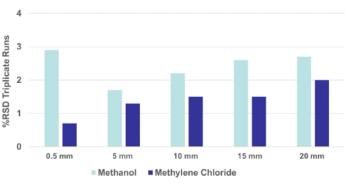
Figure 2. Split injection used to measure triplicate test of MTBE, hexane, o-xylene, and 1-methylnaphthalene comparing different solvents (methanol, methylene chloride) and column insertion distances starting with 0.5 mm, 5.0 mm, 10.0 mm, 15 mm, and 20.0 mm. Methanol had the best performance at the 5.0 mm insertion distance and methylene chloride looked slightly better at the 0.5 mm. We would still recommend not going below the 5.0 mm manufacturer recommended insertion distance.
Revisiting insertion distance for methanol and methylene chloride in GC analysis and confirming that insertion depth strongly affects response and reproducibility.
Basel, Switzerland. Old town with red stone Munster cathedral on the Rhine river. © SCStock - stock.adobe.com
SFC Europe 2026 brings global experts to Basel for courses, scientific talks, workshops, and insights into greener separation technologies.
SFE and HPLC Turn Olive Waste to Gold
Supercritical fluid extraction (SFE) and high-pressure liquid chromatography (HPLC) team up to recover olive waste antioxidants. Marina Russo of the University of Messina (Italy) discusses the details.