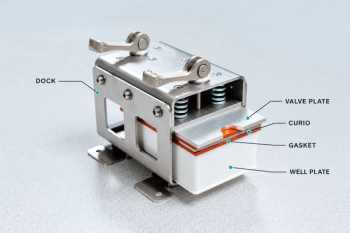
Five years after its founding, the Hungarian developer of centrifugal partition chromatography is making the case that liquid–liquid separation belongs on the analytical bench as well as the production floor.
Henri B. Kagan and Kenso Soai win 2026 Nobel Prize in Chemistry for explaining molecular handedness
The Royal Swedish Academy of Sciences announced in a press release1 that Henri B. Kagan and Kenso Soai have been awarded the 2026 Nobel Prize in Chemistry for discoveries that explain how chemical asymmetry, one of the fundamental features of life, can arise spontaneously. Their work answers a question that has puzzled chemists for more than a century, and it has shaped how pharmaceuticals are designed and made today.
Many molecules, including the amino acids that make up proteins, come in two forms that are mirror images of each other, much like a left and a right hand. Chemists call this property chirality, from the Greek word for "hand." Although both forms are possible, living organisms use only one. The proteins in our cells are built from just one version of each amino acid, and the mirror-image version is rarely found in nature. Chemists describe this one-sided chemistry of life as "homochiral," meaning "same-handed."
For a long time, it wasn't clear how this could happen. When chemists ran reactions that could produce either mirror image, they always ended up with equal amounts of both. Getting only one form wasn't just a matter of scientific curiosity. In drug development, where molecules must interact with the body, often only one mirror image has the desired effect.
"Henri Kagan and Kenso Soai have provided a solution to a chemical mystery that is over a century old: how homochirality can emerge spontaneously," said Heiner Linke, chair of the Nobel Committee for Chemistry. "The chemical reactions they have developed are spectacular."
Kagan took the first decisive step in 1986, when he discovered a new way of manipulating chemical reactions. His approach allowed him to produce a far greater excess of one mirror image over the other than chemists had believed possible.
Soai built on that foundation. In a key 1995 publication, he described the first chemical reaction designed with the potential to be fully homochiral. In 2003, he achieved that goal, presenting a reaction that produced only one of the two possible mirror images. Apart from life itself, nothing had previously accomplished this.
Together, the two laureates' discoveries show how homochirality can emerge on its own, offering insight into one of the defining chemical features of living things. Their work has also become essential to chemists who design reactions for manufacturing pharmaceuticals, where producing the right mirror image can make the difference between an effective medicine and an ineffective one.
References