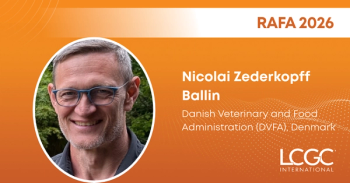
Nicolai Zederkopff explores chromatography’s role to help implement the maximum tolerable level (MTL) framework for food adulteration to translate analytical results into compliance decisions.
Jef Focant on whether workflows transfer between biological matrices, and which holds the most promise for minimally invasive disease monitoring.
At analytica 2026 in Munich, Germany, LCGC International spoke with Jef Focant from the University of Liège in Belgium, about his presentation, “GC×GC-TOFMS for Medical Volatolomics.”
In this video interview, Focant answers the following question:
Medical volatolomics is a non-invasive diagnostic field that analyzes volatile organic compounds (VOCs) emitted by the human body (in breath, sweat, urine, saliva) to detect and monitor diseases, and it has received increasing attention from the medical community in recent decades. The VOC composition found in a patient's breath or bodily fluids is associated with metabolic activity and may be influenced by various conditions. As VOCs are also present in the bloodstream, they may also reflect broader physiological states.1
Over recent years, a range of biological matrices and sampling strategies have been examined using comprehensive two-dimensional gas chromatography coupled with high-resolution time-of-flight mass spectrometry (GC×GC-HR-TOF-MS) to identify candidate biomarkers and chemical profiles for use in diagnostic models, developed in accordance with quality assurance and control protocols. Chemometric and data processing approaches were also investigated to establish data processing workflows, including validation of the statistical models used. This was applied to multi-centre breath studies across several lung conditions, including asthma subtype classification2 and the identification of metabolic changes associated with systemic sclerosis (SSc) and its pulmonary complication, interstitial lung disease (ILD).3 A metabolomics and lipidomics profiling method involving multiple derivatisation steps was also developed for blood samples from colorectal cancer (CRC) patients at various disease stages.4
Jef Focant is professor at the University of Liège, Belgium, with a focus on the application of GC×GC–TOF-MS for medical volatolomics and metabolomics applications.