|Articles|October 23, 2019

Overcoming Separation Challenges in Biological Drug Development

The landscape for new biological drug development continues to evolve in complexity. With biosimilars entering the market and originator products coming off patent, the competitive race for market dominance is reliant on!



Related to this article

Chromatography Detects Toxins in Tea Samples
High-performance liquid chromatography-tandem mass spectroscopy (HPLC–MS/MS) chromatography reveals pyrrolizidine alkaloids (PA)/pyrrolizidine alkaloid N-oxides (PANO) toxin risks in 63 tea samples.
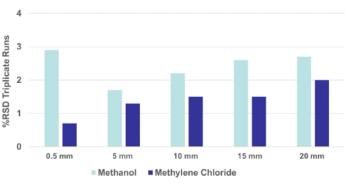
Figure 2. Split injection used to measure triplicate test of MTBE, hexane, o-xylene, and 1-methylnaphthalene comparing different solvents (methanol, methylene chloride) and column insertion distances starting with 0.5 mm, 5.0 mm, 10.0 mm, 15 mm, and 20.0 mm. Methanol had the best performance at the 5.0 mm insertion distance and methylene chloride looked slightly better at the 0.5 mm. We would still recommend not going below the 5.0 mm manufacturer recommended insertion distance.
Revisiting insertion distance for methanol and methylene chloride in GC analysis and confirming that insertion depth strongly affects response and reproducibility.