PFAS, or “forever chemicals,” are persistent synthetic compounds that accumulate in the environment and human body, increasingly entering the food chain through water, soil, and packaging. This infographic highlights their sources, health concerns, and testing challenges, emphasizing the need for advanced analytical methods and PFAS-free lab conditions to ensure accurate food safety testing.
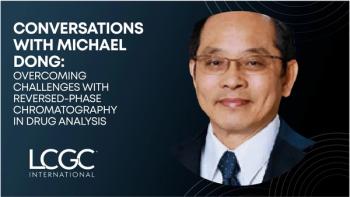
In this fifth part of " Conversations with Michael Dong," a series on fundamentals of HPLC in pharmaceutical analysis, LCGC International’s "Perspectives in HPLC" column editor discusses how to overcome challenges with reversed-phase chromatography in drug analysis.
This week on Chromatography Online, leading experts shared practical insights with LCGC International on sustainable affinity methods, siRNA impurity profiling, nontarget screening, peptide tech transfer, and AI in separation science.
Anneli Kruve reports that toxicity predictions from MS2-derived molecular fingerprints outperform spectral-similarity methods in nontarget screening of food.
In this fourth part of " Conversations with Michael Dong," a series on fundamentals of HPLC in pharmaceutical analysis, LCGC International’s "Perspectives in HPLC" column editor explains why buffers are most often used in Mobile Phase A in high-pressure liquid chromatography of pharmaceuticals.