News|Videos|November 4, 2026
AI/ML Now: Uncertainty-Driven Model-Based Search Methods for Method Development in Liquid Chromatography (Part Two)
Author(s)Gert Desmet, Leon Niezen
Leon Niezen and Gert Desmet discuss uncertainty-driven LC method development, peak overlap, and moving from in silico to real data.
Advertisement
Advertisement
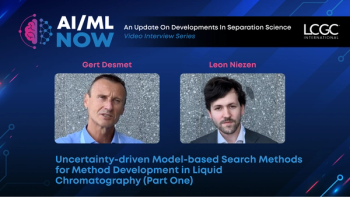
In the second episode of AI/ML Now video interview with Leon Niezen and Gert Desmet of the Vrije Universiteit Brussel about how predictive uncertainty can make automated LC method development more reliable. In model-based method development, retention models are often refined by running each new experiment wherever the chromatographic response function (CRF) looks best. Niezen and Desmet took a different route: they gave the retention models a predictive uncertainty function and used the uncertainty itself to choose the next run.
Related to this article

Leon Niezen and Gert Desmet describe how predictive uncertainty can make automated LC method development more reliable.

Sam Whitmarsh explores how retention-time models handle interlaboratory data, novel chemotypes, unusual phases and ionisable compounds, and what labs need to do to build useful in-house models.

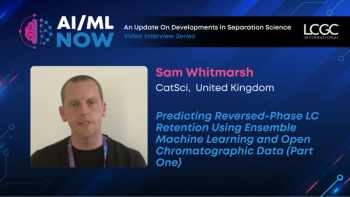
Sam Whitmarsh describes a practical workflow for predicting reversed-phase LC retention times using ensemble machine learning and open chromatographic data.

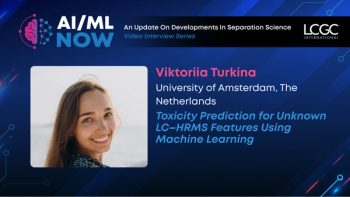
Viktoriia Turkina discusses toxicity prediction for unknown LC–HRMS features using machine learning.

ChromSoc’s Data Analytics and AI in Chromatography symposium will debate whether AI could ever replace chromatographers, alongside pharma case studies.

Amandaa Brewer warns a shortage of large-molecule chromatography experts, as practitioners retire, could leave the next generation without the fundamentals.

Liquid chromatography–tandem mass spectrometry (LC–MS/MS) reveals distinct sphingolipid patterns in anorexia and obesity.
Advertisement
Advertisement