When it comes to water analysis, it can be challenging for labs to keep up with ever-changing testing regulations while also executing time-efficient, accurate, and risk-mitigating workflows. To ensure the safety of our water, there are a host of national and international regulators such as the US Environmental Protection Agency (EPA), World Health Organization (WHO), and the European Union (EU) that demand stringent testing methods for drinking water and wastewater. Those methods often call for fast implementation and lengthy processes, as well as high sensitivity and reliable instrumentation. This paper explains how your ICP-MS, ICP-OES, and LC-MS-MS workflows can be optimized for compliance with the latest requirements for water testing set by regulations like US EPA methods 200.8, 6010, 6020, and 537.1, along with ISO 17294-2. It will discuss the challenges faced by regulatory labs to meet requirements and present field-proven tips and tricks for simplified implementation and maximized uptime.
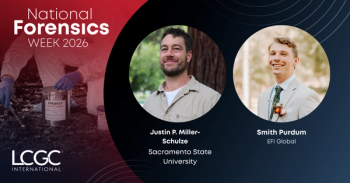
Justin Miller-Schulze and Smith Purdum explain how machine learning and chemometrics can improve fire debris classification in forensic science applications.
This week, the Chromatography Online website observed National Forensic Science Week with expert interviews on how chromatography helps solve cases, plus career stories from women in analytical science and new research on detecting rat poison in cats and tracking mold toxins in gluten-free pasta.
Kinjal Bhatt argues inclusion advocacy shouldn't fall on women alone, while Ina Varfaj credits sharing the load and learning to say no for avoiding burnout.
Steven Ray Wilson defines organ-on-a-chip as organoids on microfluidic devices, tracing their small, complex samples to the case for automated online LC–MS.