Multidimensional chromatography cuts ion suppression in complex environmental samples by separating salts and coeluting compounds from target analytes.
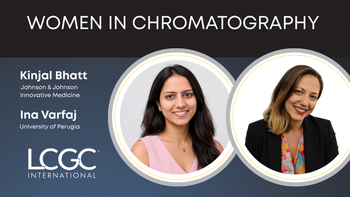
Kinjal Bhatt and Ina Varfaj trace their pull toward analytical science to a saturated chromatography peak and the moment their first chiral peaks separated.
“The tools have changed, but the question is still the same that I'm looking for always: what's really going on behind the surface?”
— Kinjal Bhatt, Senior Scientist, Johnson & Johnson Innovative Medicine
When I separated my first peaks, it was amazing.”
— Ina Varfaj, Postdoctoral Researcher, University of Perugia
For many analytical scientists, the pull toward the field rarely comes down to a single moment. In this panel conversation, Kinjal Bhatt, senior scientist at Johnson & Johnson Innovative Medicine, and Ina Varfaj, postdoctoral researcher at the University of Perugia, trace their paths into the discipline back to a curiosity that started well before either set foot in a lab. Bhatt recalls a childhood neighbor who worked in the pharmaceutical industry and could read a drug label like they held a superpower, sparking her early fascination with what medicine is made of and how scientists know it is safe and effective. Later, a formative internship mistake with liquid chromatography (LC) gave that curiosity a practical edge: told to prepare a very low-concentration solution, she made it too strong and produced a fully saturated peak, a memory that still sticks with her. The experience taught her the real gap between theory and practice, and reminded her that analytical work often advances through careful troubleshooting as much as through textbook knowledge. That same instinct for understanding what is happening beneath the surface, she says, still drives her work today across multidimensional chromatography, data science, and AI.
Varfaj’s route ran through a pharmacy degree in Italy and a master’s thesis she nearly skipped, before a PhD in analytical chemistry pulled her toward chiral compounds and in silico enantiorecognition modeling. She describes separating her first peaks as the moment the science truly clicked, launching an enthusiasm for chirality she has carried ever since. For both, a career in chromatography was shaped by accidents, mentors, detours, and the willingness to keep asking better questions. Their stories also underline the value of persistence: early uncertainty did not close doors, but instead helped each scientist find a more personal connection to the field. As chromatography becomes increasingly intertwined with advanced computation and artificial intelligence, both Bhatt and Varfaj suggest that the core motivation remains familiar. The tools may evolve, but the work still begins with curiosity, close observation, and the desire to understand what is really going on beneath the surface.
To view more Women in Chromatography discussions, please click
15 days ago
Revisiting Column Insertion Distance15 days ago
A Preview of SFC Europe 2026