|Articles|April 12, 2012
E-Separation Solutions
- E-Separation Solutions-04-12-2012
- Volume 0
- Issue 0
Using Multiple Analytical Techniques in Non-Targeted Analysis of Food Products
Traditional approaches for measuring food components are based on a ?target list? approach, whereby specific methodologies are developed for individual or related compounds. Such methods are well-suited for routine monitoring but can fail to detect emerging contamination events or to identify new prospects for product development.
Advertisement
Traditional approaches for measuring food components are based on a ‘target list’ approach, whereby specific methodologies are developed for individual or related compounds. Such methods are well-suited for routine monitoring but can fail to detect emerging contamination events or to identify new prospects for product development.
Articles in this issue
over 14 years ago
Detecting Emerging Contaminants in Food with Nontargeted Analysisover 14 years ago
Schug to Lead New Shimadzu Center at UT ArlingtonAdvertisement

Related to this article

Liquid chromatography-tandem mass spectrometry (LC-MS/MS) finds high fentanyl levels do not predict toxicity in tolerant users.

Gas chromatography-ion mobility spectrometry (GC-IMS) identifies odor markers that flag early mold growth in cigar tobacco.

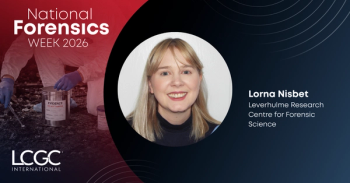
Lorna Nisbet from the Leverhulme Research Centre for Forensic Science, discusses a GC–MS. technique developed to detect anabolic-androgenic steroids in e-cigarettes seized from Scottish prisons.

Kinjal Bhatt and Ina Varfaj trace their pull toward analytical science to a saturated chromatography peak and the moment their first chiral peaks separated.

Gérard Hopfgartner explains why pairing SFC with dopant-assisted APPI can match, or even beat, electrospray sensitivity, even at microflow LC rates.

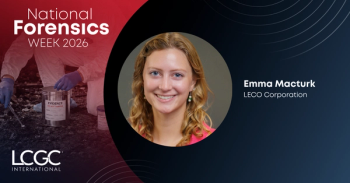
Emma Macturk from LECO Corporation explains which forensic applications benefit from GC×GC’s greater peak capacity, and when the additional separation power may only provide limited benefits.

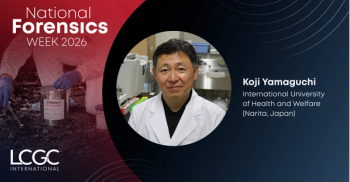
Koji Yamaguchi of the International University of Health and Welfare (Narita, Japan) discusses a novel derivatized liquid chromatography-tandem mass spectrometry (LC-MS/MS) method plus propofol glucuronide (PRG) marker which improves forensic propofol detection.
Advertisement
Advertisement
Trending on LCGC International
1
GC-MS Uncovers Cocoa Variety's Chocolate Aroma
2
Using UHPLC-MS/MS to Help Pinpoint Time of Death
3
The Case for Radical Cations: Bringing EI-Style Spectra to LC–MS
4
Peaks & Pioneers: Isabelle Kohler on Life Beyond the Traditional Academic Track
5