Articles by Hans-Joachim Hubschmann

A fully automated quick, easy, cheap, effective, rugged, and safe (QuEChERS) extraction and extract clean-up method is described for analysis of organophosphate pesticides in orange juice. This method uses GC–MS and LC–MS along with an industry standard robotic x,y,z-sampling system.

Analysis of OCPs, PAHs and PCBs in environmental samples through a consolidated GC-MS/MS method using the Thermo Scientific™ TRACE™ 1310 GC and the TSQ™ 8000 triple quadrupole GC-MS/MS.

Thermo Fisher Scientific Application Note
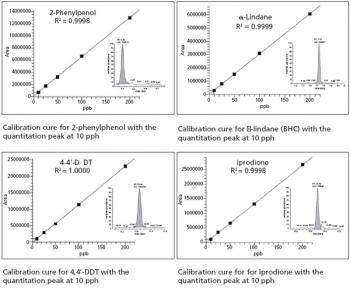
International regulations on maximum residue levels (MRLs) of pesticides in food cover hundreds of individual contaminants at the 10 ppb or below range. The analysis of citrus oil for pesticide contamination holds specific challenges.
Pesticides are widely used in agriculture to protect crops and to improve efficiency of production. Consequently, governments, food producers and food retailers have a duty to ensure that any residues occurring in foods for human consumption are at or below statutory maximum residue levels (MRLs). Regulation EC 396/2005 adopted in the European Union sets MRLs for more than 500 different pesticides in over 300 different food commodities.

Polychlorinated biphenyls (PCBs) are a class of extremely persistent industrial chemicals manufactured for use in electrical transformers, capacitors, inks, paints, pesticides, dust control or insulating fluids. Estimates have put the total global production of PCBs on the order of 1.5 million tons.
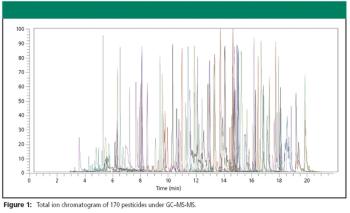
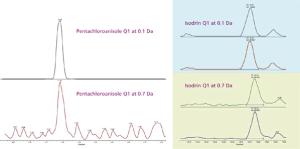
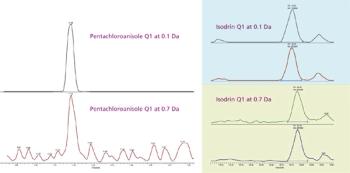
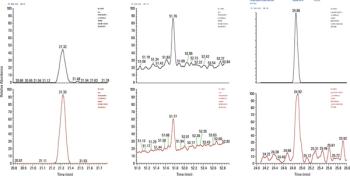
H-SRM provides excellent selectivity for accurate identification and quantification of pesticides in matrix, demonstrating high productivity for effective control at international maximum residue levels (MRLs).

Polybrominated diphenyl ethers (PBDEs) are among the most important and widely used flame retardants. Recent legislation banned certain PBDE congeners.? EU directive 2003/11/EC prohibits the use of Penta-BDE and Octa-BDE for the member states of the European community.? Therefore, analysis of PBDEs have received increased interest as a result of their known toxicity.